
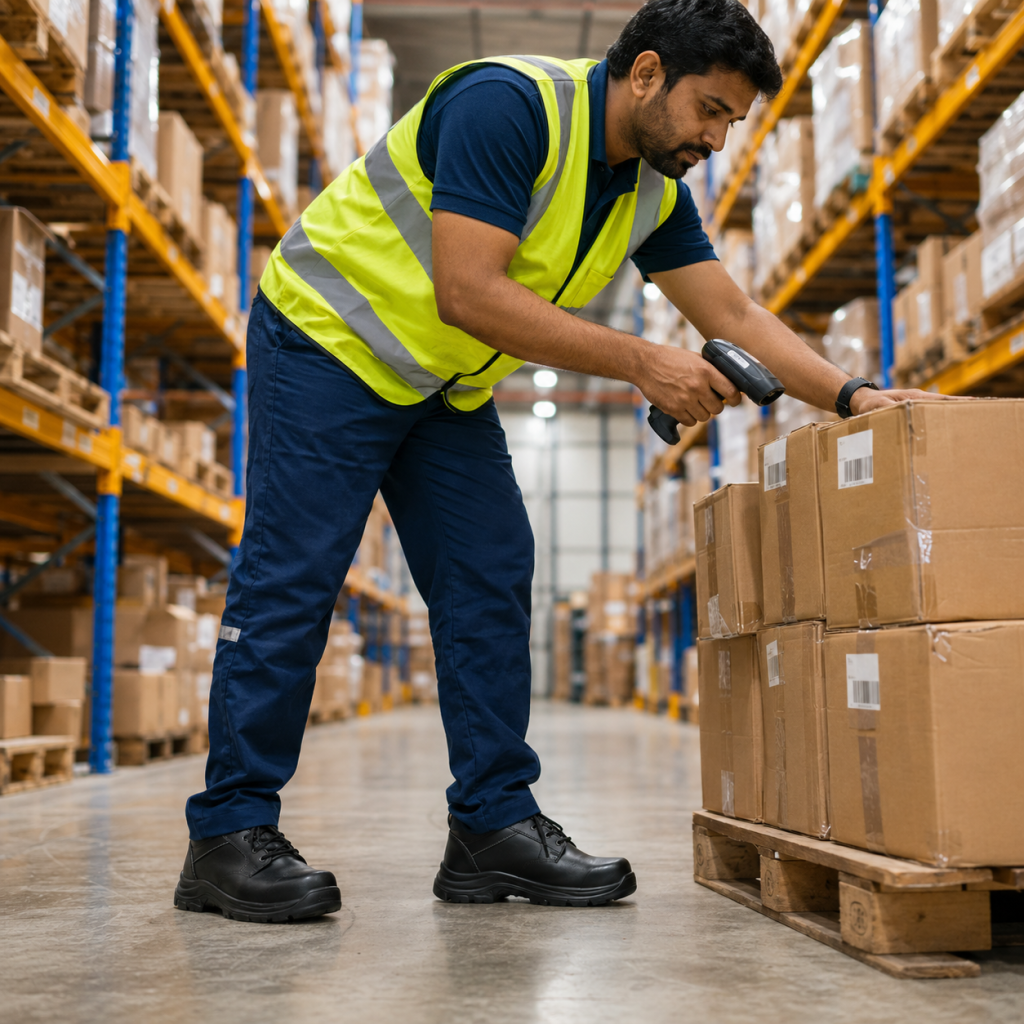
India’s logistics and warehousing sector is growing at a rate that few other industries can match. With USD 243 billion in market size in 2025 and a projected 6.5% compound annual growth rate through 2034, driven by Make in India, PLI schemes and the e-commerce explosion, the industry is adding millions of square feet of warehousing capacity and hundreds of thousands of workers each year. The safety infrastructure for this workforce has not always kept pace with the growth.
For safety officers, operations managers and procurement teams in logistics, this guide maps the specific hazards of warehousing and distribution environments and provides a practical footwear specification framework.
The Logistics Hazard Profile
Logistics environments have a footwear hazard profile that is often underestimated compared to heavy manufacturing. The combination of high foot traffic, heavy vehicle movement, repetitive manual handling, and varied floor surfaces makes logistics one of the highest-injury environments for foot and ankle injuries in Indian industry.
| Zone | Primary Foot Hazards | Recommended Footwear |
|---|---|---|
| Loading dock / bay doors | Forklift proximity, heavy package drop, wet surface in rain | Steel toe with SRB anti-slip — Hawk PU or PVC in monsoon |
| Racking aisles | Falling inventory, narrow passages, forklift traffic | Steel toe with ankle support, anti-slip |
| Goods receipt area | Heavy inbound goods, pallet jack movement | Steel toe — full IS:15298 specification |
| Pick and pack | Long standing, repetitive, ergonomic fatigue | Cushioned PU — Jumbo Z+ PU for 8–12 hour shifts |
| Cold store / refrigerated zone | Slip on frost, cold temperature stress | Insulated PVC or thermal PU |
| Despatch and sortation | Moving conveyor hazards, package drop | Steel toe anti-slip |
| Outdoor yard | Uneven ground, vehicle movement, monsoon waterlogging | PVC gumboot in monsoon; steel toe PU otherwise |
The Forklift Proximity Problem
In warehouses where forklifts and workers share the same floor space, the risk of crush injury to feet is significant. A typical forklift loaded with pallets exerts a static load of 4,000–8,000 kg. IS:15298 specifies 200-joule impact and 15kN compression — sufficient for most falling object scenarios, but the primary protection against forklift wheel contact is spatial — marking, barriers, pedestrian lanes, speed limits.
This is an important point: safety footwear in a forklift environment is a last-resort protection, not a primary control. Facilities should prioritise forklift management systems and pedestrian segregation above footwear specification, while ensuring the footwear specification is correct for the residual risk.
India’s Logistics Growth and Safety Implications
The Indian logistics sector absorbed 72.5 million square feet of warehousing in 2025 alone — a 29% year-on-year increase. Many of these new facilities are operated by companies deploying large workforces rapidly. The safety challenge in fast-scaling logistics operations is maintaining PPE discipline as headcount grows faster than safety systems.
For logistics operators scaling rapidly, a standardised safety footwear programme with a defined model for each zone type, an automated replacement trigger system, and a central procurement agreement with a reliable supplier reduces the risk of safety gaps in a growing workforce.
Monsoon Planning for Logistics Operations
Loading docks, outdoor yards, and goods receipt areas are among the most severely affected environments during the Indian monsoon. Rain tracking on concrete floors from wet outdoor areas dramatically increases slip risk across the entire warehouse. Pre-monsoon footwear planning for logistics facilities should include:
- Replace PU shoes in outdoor and dock-adjacent zones with PVC anti-slip models for the season
- Issue gumboots for outdoor yard workers
- Increase floor cleaning frequency near entry points — footwear alone cannot compensate for contaminated floors
- Inspect and replace worn footwear before monsoon onset — wet conditions accelerate sole wear dramatically
Bulk Procurement for Multi-Warehouse Operations
Logistics companies operating multiple warehouses across India face the challenge of consistent specification and reliable supply across diverse locations. A pan-India supply agreement ensures that the same specification is applied at Chennai, Pune, Bengaluru and Delhi warehouses without local sourcing variations that undermine compliance documentation.
Related Reading
- PU vs PVC Safety Shoes — Which Does Your Industry Need?
- Anti-Slip Safety Shoes — The Most Undervalued Safety Property
- Safety Shoe Replacement Schedule for Indian Industry
- Safety Footwear Procurement Guide