
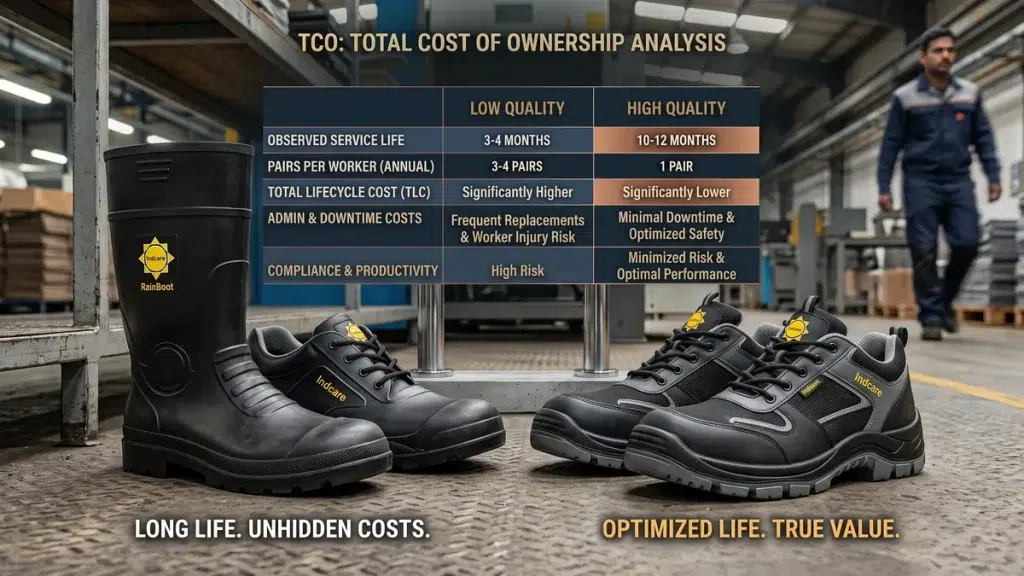
A purchase manager is handed two quotes. One boot at ₹900, one at ₹1,650. The specification sheets look similar. The cheaper option saves ₹750 per pair, and across 400 workers that is ₹300,000 off the annual PPE line. On a spreadsheet, the decision looks obvious.
Eleven months later the same manager is placing a third replacement order for the year, fielding complaints about workers refusing to wear the boots, and dealing with a lost-time injury where the outsole had worn smooth. The ₹300,000 saving is long gone.
This is not an argument that expensive footwear is always better. Plenty of premium-priced footwear is poor value, and plenty of mid-market footwear is excellent. It is an argument that unit price is the least useful number in the decision, and that a small amount of arithmetic gives you a far better basis for comparison.
Cost Per Wear: The Only Number That Compares Fairly
The metric that makes two quotes comparable is cost per wear — what one day of protected work actually costs you.
The calculation is simple:
Run it on the two quotes above, using service life observed in practice rather than claimed on a brochure:
| Budget boot | Mid-market boot | |
|---|---|---|
| Unit price | ₹900 | ₹1,650 |
| Observed service life | 4 months | 11 months |
| Working days (26/month) | 104 days | 286 days |
| Cost per wear | ₹8.65 | ₹5.77 |
| Annual cost per worker | ₹2,700 (3 pairs) | ₹1,650 (1 pair) |
| Annual cost, 400 workers | ₹10,80,000 | ₹6,60,000 |
The “cheaper” boot costs roughly ₹4.2 lakh more per year across the workforce. And that is before a single indirect cost is counted.
Note what makes this calculation honest: the service life figure comes from observation, not from a supplier claim. If you do not have that data, our guide on running a structured wear trial explains how to get it in eight weeks.
The Costs That Never Appear on the Invoice
Cost per wear captures the direct purchase cycle. It misses several categories that are often larger.
Administrative cost per replacement cycle
Every replacement round consumes time that nobody bills to the PPE budget: raising the requisition, collecting sizes, chasing the supplier, receiving and checking stock, distributing, updating issue records, disposing of old pairs.
For a 400-worker site, a replacement cycle realistically consumes several person-days across stores, HSE and admin. Three cycles a year instead of one means you are paying for that twice more than you need to.
Productivity loss from discomfort
This is the cost most organisations never measure and most workers will tell you about immediately. Footwear that is heavy, hot, poorly fitted or stiff produces:
- Shortened effective working time as workers seek opportunities to sit
- Slower movement across site, which compounds across a shift
- Higher absence from foot pain, blistering and lower-back complaints
- Workers loosening laces or removing footwear during breaks and delaying return
Non-compliance, the most expensive outcome of all
Uncomfortable footwear does not get worn properly. Workers slip the heel off, leave laces undone, or swap into their own shoes when a supervisor is not present. At that point you have paid for protection you are not receiving.
A boot that costs 40% less and is worn correctly 60% of the time is not a saving. It is an unprotected workforce with a paper trail suggesting otherwise.
Injury cost
A single lost-time foot injury carries direct medical cost, wage continuation, replacement labour, investigation time, potential regulatory attention, and an insurance impact that persists for years. Against that, the entire annual footwear budget for a mid-sized site is small.
The argument here is not that good footwear eliminates injuries. It is that footwear is one of the cheapest risk controls available, and under-specifying it to save a few hundred rupees per worker is a poor trade on expected value alone.
Where Cheap Footwear Actually Fails
Understanding why low-cost footwear has a short service life helps you spot it during evaluation rather than after twelve weeks of wear.
Outsole bonding
The join between upper and sole is the single most common failure point. Direct-injection and vulcanised construction bond the sole into the upper material. Cheaper cemented construction relies on adhesive, which degrades faster under heat, oil and flexing.
In Indian summer conditions and Gulf heat, adhesive failure accelerates sharply. A sole that separates at the toe is not repairable in practice and takes the boot out of service immediately.
Outsole compound and density
A single-density PU sole is cheaper to produce than a dual-density construction. Dual-density combines a softer cushioning layer against the foot with a harder, more abrasion-resistant outer layer.
Single-density soles wear smooth faster. Once the tread pattern is gone, slip resistance is gone with it, regardless of what the original certification said.
Upper material quality
Split leather and coated synthetics cost less than full-grain leather and crack earlier under repeated flex, especially after heat cycling. Once the upper cracks, water ingress follows and the lining breaks down.
Insole and footbed
A thin die-cut foam insole compresses permanently within weeks. The boot may look serviceable while offering no meaningful cushioning, which is where fatigue and discomfort complaints originate.
Counterfeit and misrepresented certification
The floor of the market includes footwear carrying markings it was never tested against. This is not a value trade-off — it is a boot that will fail at the moment it matters. Our article on identifying fake and substandard safety shoes covers verification in detail.
Building a TCO Model You Can Defend
You do not need a complex model. You need one that survives a conversation with finance.
Include these lines, per worker, per year:
- Footwear unit price multiplied by expected replacements per year
- Freight and handling, apportioned per pair
- Administrative cost per replacement cycle, apportioned per worker
- Estimated productivity impact where comfort differs materially between options
- Expected injury cost, weighted by probability, where protection levels differ
Then present the comparison as annual cost per worker rather than unit price. This reframing matters more than the precision of any individual estimate, because it moves the conversation from “which is cheaper” to “which costs less to run.”
Where Spending More Genuinely Does Not Help
An honest TCO analysis cuts both ways. There are situations where premium footwear is simply over-specification, and buying it wastes money without improving safety.
- Metatarsal guards for workers who never handle objects heavy enough to warrant them — added weight, no benefit
- Heat-resistant outsoles for indoor assembly work at ambient temperature
- Waterproof construction for consistently dry environments, where it reduces breathability
- Full-grain leather for light-duty roles with low abrasion exposure
- Imported brands where a compliant domestic equivalent tests to the same standard
The goal is not maximum specification. It is the lowest cost per wear that fully covers the hazards actually present in each work zone — which is why zone-by-zone specification usually beats a single site-wide standard.
The Procurement Conversation That Works
If you need to justify a higher unit price internally, the framing that lands is rarely a safety argument. It is a cost argument that happens to improve safety.
Three points, in this order:
- Annual cost per worker — lead with the number that is lower, not the unit price that is higher
- Replacement cycles avoided — one procurement round a year instead of three, with the admin time that frees up
- Risk position — brief, factual, no dramatics: the higher-specification option closes a hazard gap that the alternative leaves open
Bring the wear-trial data if you have it. A finance director who has seen an observed service life of four months against eleven, from your own site, does not usually need convincing twice.
Conclusion
Unit price is the number that is easiest to compare and the least useful for deciding. Cost per wear takes about two minutes to calculate and routinely reverses the ranking of two quotes. Add administrative cost, comfort-driven compliance, and expected injury cost, and the gap usually widens further.
The practical next step is not to switch suppliers. It is to find out how long your current footwear actually lasts in your actual conditions, because almost nobody measures that — and without it, every comparison you make is guesswork dressed up as procurement.