
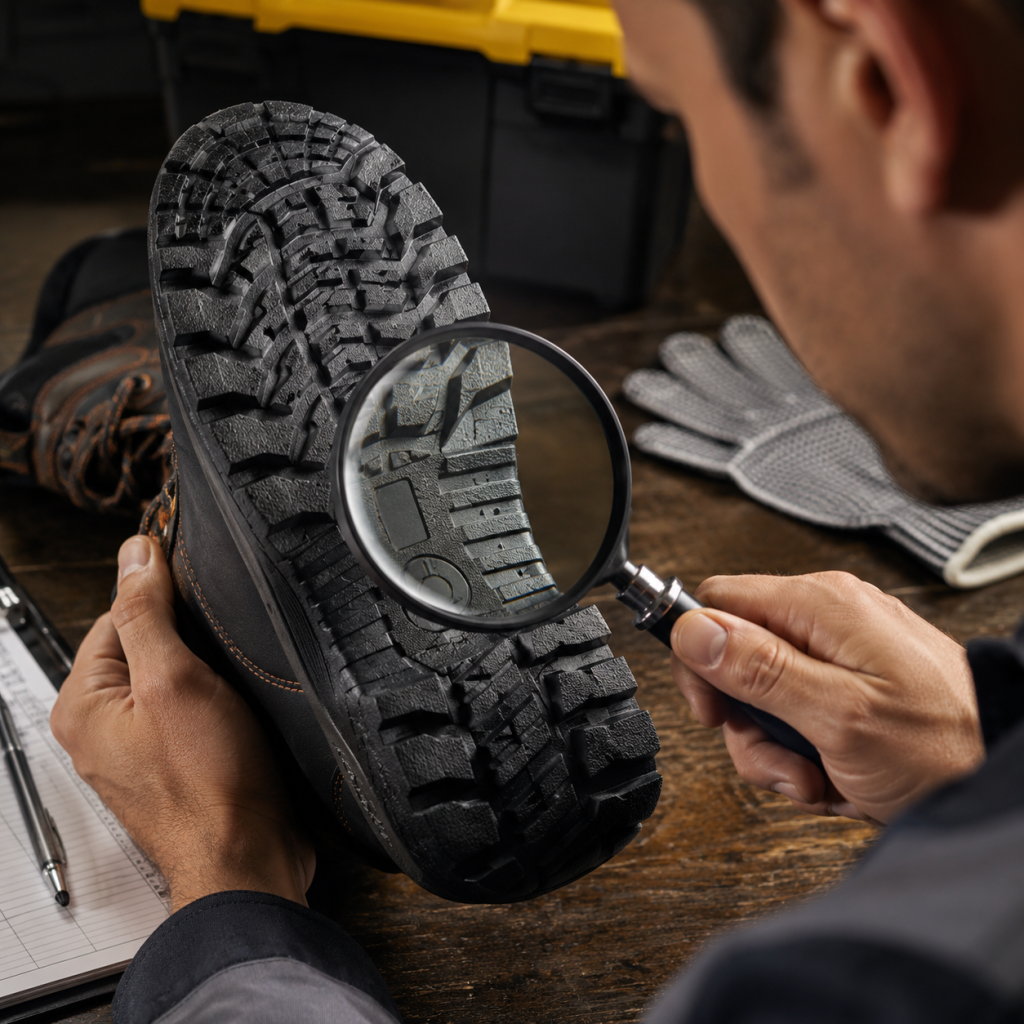
India’s industrial PPE market has a well-documented problem with counterfeit and substandard safety shoes. Products that look like safety shoes, may even reference IS:15298 on their label, but provide no meaningful protection — available at prices that attract cost-conscious procurement managers.
7 Signs of Fake or Substandard Safety Shoes
- No ISI mark on the physical product — certified shoes must carry the ISI mark stamped on the shoe itself, not just on documentation
- Cannot provide a BIS Licence number — format CM/L-XXXXXXX, verifiable at bis.gov.in
- Price significantly below market — genuine certified shoes have a minimum production cost. Implausibly low prices mean the standard is not being met
- Sole compresses easily under hand pressure — a legitimate PU midsole resists compression and recovers; cheap foam does not
- Sole separates at the welt — flex the shoe at the sole welt; quality construction shows no tendency to separate
- No detectable firm midsole plate — fold the sole mid-point; a penetration plate resists folding
- Cannot provide a test report — from a NABL-accredited laboratory confirming IS:15298 compliance
Buying from Mittal Safety Works
Every Indcare shoe carries the ISI mark. We provide our BIS licence number verifiable on the BIS portal. We provide NABL-accredited test reports on request. No need to take our word for compliance — verify it independently.
View Certifications Request a Quote
How the Counterfeit Safety Shoe Market Works in India
India’s large, price-sensitive industrial PPE market creates commercial incentives for counterfeit and substandard safety footwear. Three categories of problematic products circulate in the market:
- Counterfeit BIS-marked shoes — carrying a fake IS:15298 ISI mark that has never been tested or certified. The mark looks identical to a genuine BIS mark; verification requires checking the licence number on bis.gov.in.
- Safety-style shoes without certification — shoes that look like safety shoes (steel-colour toe box, work shoe aesthetics) but contain no certified steel toe cap and have not been tested to IS:15298. These often carry no BIS mark at all.
- Expired certification — shoes from a manufacturer whose BIS licence has lapsed but continues to mark products. The licence number may return a result on the BIS portal but with an expired validity date.
Seven Physical Tests You Can Perform at Inspection
- Toe cap squeeze test — grip the toe box between thumb and forefinger and squeeze firmly. A genuine steel toe cap should not flex at all. Any give indicates no steel toe or a compromised cap.
- Toe box tap test — tap the toe area firmly with a knuckle. A steel toe cap produces a distinct metallic resonance. Plastic or hollow caps sound different.
- Sole flexibility test — bend the shoe at the ball. Genuine safety shoe soles should be firm with controlled flex. Cheap soles bend excessively and may separate from the upper.
- Welt adhesion check — run a thumbnail around the welt where the upper meets the sole. On substandard shoes, the adhesive bond separates easily with light finger pressure.
- Tread depth check — press a ruler or toothpick into the deepest tread channel. On new shoes, this should be at least 4mm. Shallow tread on a new shoe indicates a cost-cut sole compound.
- Upper material check — on PVC shoes, the upper should be uniformly smooth and dense. Thin, papery PVC that crinkles easily will not last a month in industrial use.
- BIS mark legibility — the BIS ISI mark on a genuine certified shoe is moulded or stamped clearly into the sole or upper. Smudged, stickered, or loosely applied marks are a red flag.
What Substandard Footwear Actually Means in Practice
An unverified steel toe shoe in a 200-joule impact scenario may deform into the toes rather than holding shape. A sole compound that has not been tested for slip resistance may provide less friction than a bare foot on a wet surface. A poorly adhered welt may separate from the upper in a chemical environment, allowing liquid ingress directly to the foot.
These are not theoretical risks — they represent the actual failure modes of products that do not meet IS:15298. The reason the standard exists is precisely because these failures occur when products are not certified.
How to Protect Your Procurement
- Always verify BIS licence number at bis.gov.in before placing an order
- Request the BIS certificate document — not just a photocopy; confirm it is current
- Request the ISO 9001 certificate from the manufacturer — legitimate manufacturers have documented quality systems
- Be cautious of prices significantly below market rate — the cost of correct materials and certification is reflected in price
- Inspect a physical sample before bulk order
Related Reading
- IS:15298 Explained — What Certification Means
- Safety Footwear Procurement Guide
- Government and PSU Procurement — Documentation Requirements