
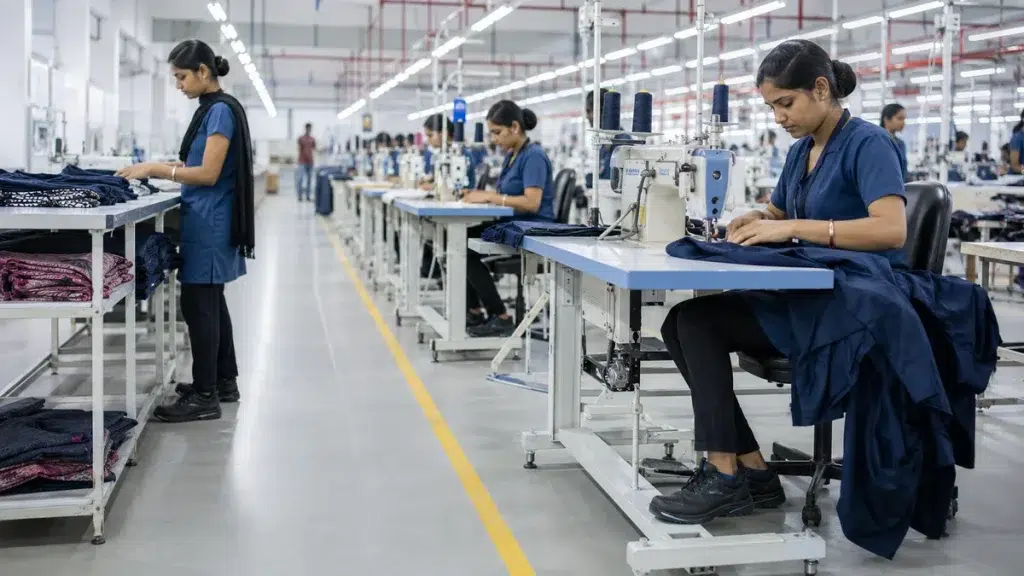
India’s textile and garment industry employs over 45 million workers across fabric mills, spinning units, power loom facilities, hosiery plants, and apparel manufacturing. Despite this scale, the sector has historically underinvested in safety footwear — with the misperception that textile work is “light industry” requiring no PPE. This article explains why that view is wrong.
The Real Hazards in Textile and Garment Manufacturing
- Loom components regularly moved and handled — drop risk is real
- Fabric bales and carton trolleys on loading docks create compression hazard
- Machine oiling creates oil-contaminated concrete — significant slip risk
- Textile dye houses and chemical treatment baths create wet floor conditions
- Plantar fasciitis, knee and lower back pain from inadequate footwear
- Fatigue increases error rates and accident risk in the second half of shifts
Specification by Role
| Role | Specification | Key Properties |
|---|---|---|
| Spinning/weaving floor | S1 minimum, S2 preferred | Toe cap, anti-static, slip resistance, cushioned insole |
| Loom maintenance/fitter | S2 or S3 | Toe cap, anti-static, penetration-resistant midsole |
| Fabric dyeing/wet processing | S2 SRC | Water-resistant upper, SRC slip resistance |
| Garment assembly (sewing) | OB or S1 | Ergonomics, slip resistance, lightweight |
| Packing and dispatch | S1 SRC | Toe cap, slip resistance, comfortable for movement |
| Loading dock/warehouse | S2 or S3 | Toe cap, penetration midsole, energy-absorbing heel |
The Women’s Footwear Gap
Approximately 60–70% of garment manufacturing workers in India are women. Safety footwear has historically been designed for men, with women offered ill-fitting smaller sizes rather than purpose-designed footwear. This leads directly to non-compliance — workers remove uncomfortable shoes.
When procuring for female workforces, specify: women-specific lasts, lightweight construction (under 500g per shoe), low-to-mid ankle profile, slip-resistant outsole, and anti-fatigue insole.
The Cost Per Use Argument
Cheap unbranded safety shoe at ₹350 lasts 3 months — cost over 12 months: ₹1,400 per worker. Quality IS:15298 certified shoe at ₹950 lasts 9–12 months — cost over 12 months: ₹950 per worker. The quality shoe is 32% cheaper annually — before factoring in a single injury claim.
Compliance Pressure Is Growing
India’s Factories Act 1948 mandates PPE provision. Labour inspections in textile clusters have increased in frequency. Global buyers — particularly European and US brands sourcing from India — increasingly require documented PPE compliance as part of SA8000, SMETA, and BSCI supplier audits. BIS-certified safety footwear with documented issuance records is the correct response.
Conclusion
The textile and garment sector employs tens of millions of workers who deserve better foot protection. The hazards are real — falling objects, oily floors, sharp objects, and chronic standing fatigue — and the solutions are available at accessible price points. Once cost-per-use is calculated honestly, quality safety footwear is the cheaper option. The compliance trend is only moving in one direction.