
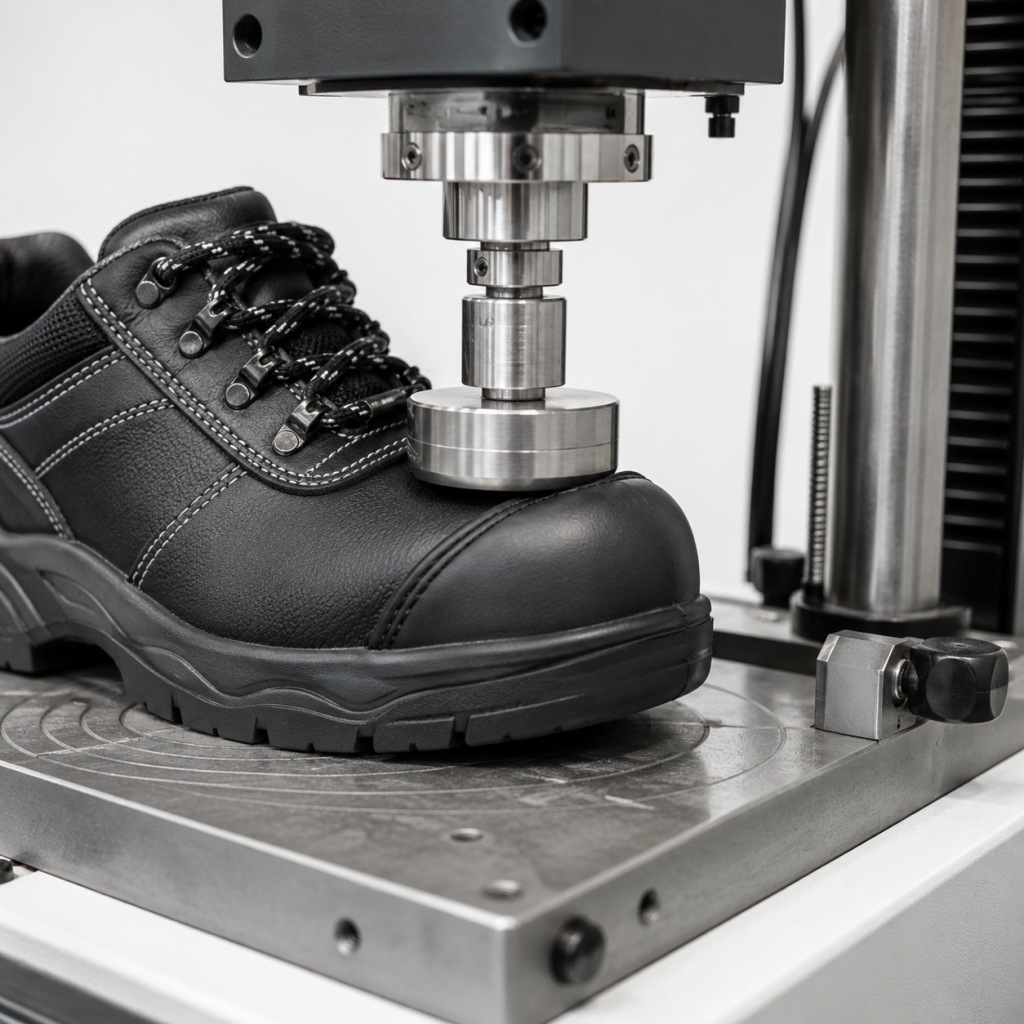
IS:15298 is the Bureau of Indian Standards specification for occupational safety footwear. It is the Indian equivalent of the European EN ISO 20345 standard and establishes minimum performance requirements for safety shoes sold in India. For procurement managers, safety officers, factory inspectors, and compliance teams, understanding what IS:15298 actually tests — and what it does not — is essential to making correct purchasing decisions.
The Structure of IS:15298
IS:15298 is a multi-part standard. The most relevant part for most industrial procurement is Part 2, which covers safety footwear for general industrial use. Part 1 covers terminology and Part 3 addresses specific additional properties.
| IS:15298 Part | Coverage |
|---|---|
| Part 1 | Terminology, definitions, classification |
| Part 2 | Requirements and test methods for safety footwear |
| Part 3 | Additional safety requirements (heat resistance, anti-static, etc.) |
What IS:15298 Part 2 Actually Tests
Every safety shoe carrying the IS:15298 BIS certification mark has been tested against the following parameters. These are not aspirational — they are minimum mandatory thresholds that every certified pair must meet.
| Test Parameter | IS:15298 Minimum Requirement | What It Means in Practice |
|---|---|---|
| Toe cap impact resistance | 200 joules — no contact with test toe form | Protects against a 20kg object falling from 1 metre |
| Toe cap compression resistance | 15 kN — no contact with test toe form | Equivalent to approximately 1,500 kg static load |
| Slip resistance (SRB) | Coefficient of friction ≥ 0.28 on ceramic tile with SLS solution | Anti-slip performance on wet smooth surfaces |
| Outsole energy absorption | ≥ 20 joules at heel | Cushioning under heel to reduce fatigue and impact stress |
| Outsole oil resistance | Volume change ≤ 12% in IRM 902 oil after 22 hours | Sole does not swell or degrade in oil environments |
| Outsole abrasion resistance | Volume loss ≤ 200 mm³ | Sole lasts against abrasive floor surfaces |
| Upper tear strength | ≥ 100 N (PU/PVC uppers) | Upper resists tearing from sharp edges and debris |
| Lace holding strength | ≥ 60 N per eyelet | Eyelets do not pull out under use stress |
What IS:15298 Does NOT Certify
This is where many procurement errors originate. IS:15298 certification does not automatically confer protection against:
- Electrical hazard — shoes must meet additional ESD or anti-static requirements (IS:15298 Part 3 or separate testing) for electrical work
- Acid and chemical resistance — the oil resistance test covers petroleum-based oils only; chemical resistance to acids, alkalis and solvents requires separate specification
- Heat resistance — standard IS:15298 does not certify sole integrity at elevated temperatures; heat-resistant soles require separate Part 3 testing
- Metatarsal protection — toe cap only; metatarsal guards are an additional feature not covered by the base standard
- Waterproofing above the ankle — the standard tests water penetration resistance of the sole, not the upper
IS:15298 vs EN ISO 20345 — Key Differences
For procurement teams sourcing for export operations or facilities with multinational parent companies that specify EN ISO 20345, here is the practical comparison:
| Parameter | IS:15298 Part 2 | EN ISO 20345:2022 |
|---|---|---|
| Toe cap impact | 200 J | 200 J |
| Toe cap compression | 15 kN | 15 kN |
| Slip resistance | SRB (ceramic + SLS) | SRC (ceramic + SLS + steel + glycerol) |
| Scope of base standard | Core protection + oil resistance | Broader base requirements including heel energy absorption specification |
| Certification body | Bureau of Indian Standards (BIS) | Notified Bodies in EU |
| Legal requirement in India | Yes — for Indian factories | Not required under Indian law |
How to Verify BIS Certification When Purchasing
- Ask the supplier for the BIS licence number for the specific model
- Check bis.gov.in — search under “IS:15298” to verify the licence is current
- Check the physical shoe — the BIS ISI mark should appear on the shoe itself, not just the packaging
- Request the latest BIS test report — legitimate manufacturers can provide these
- Check that the model name on the BIS licence matches the model you are purchasing
Related Reading
- PU vs PVC Safety Shoes — Which Does Your Industry Need?
- How to Identify Fake or Substandard Safety Shoes in India
- Safety Footwear Compliance for Government and PSU Procurement
- Safety Shoe Buying Guide — What Every Procurement Manager Should Know