
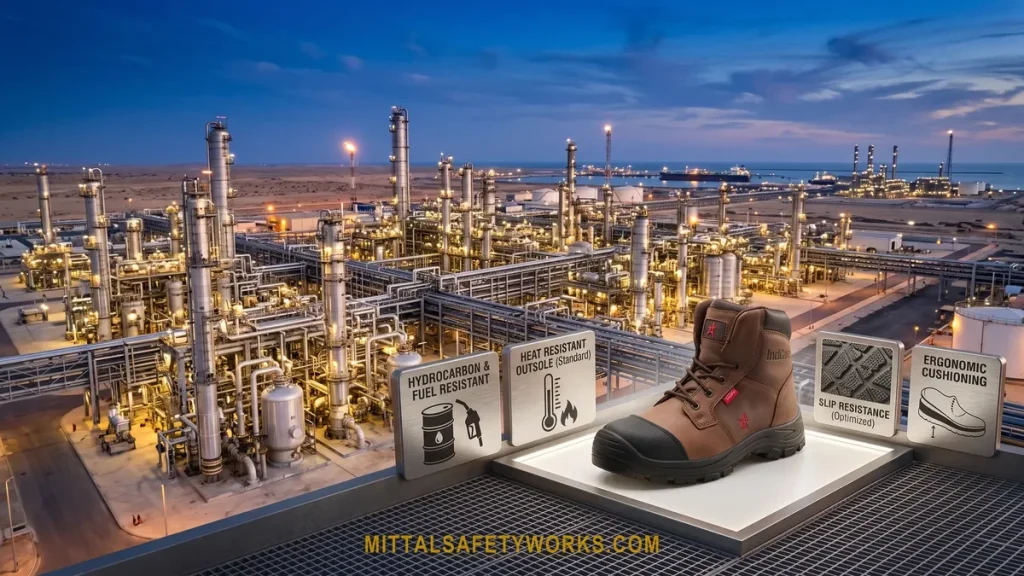
ADIPEC 2026 runs from 2 to 5 November 2026 at ADNEC in Abu Dhabi. It is one of the largest energy industry gatherings in the world, and while footwear is not the headline, a substantial share of the procurement decisions made around it end up specifying PPE for refineries, gas processing plants, tank farms and offshore support operations.
Oil and gas is also the sector where safety footwear specification goes wrong most often. Not because buyers are careless, but because the hazard profile combines four different risks that map to four different markings — and a high class code like S3 covers none of them.
This article covers what an oil and gas specification actually needs, and the one confusion that carries the most serious consequences.
The Hazard Profile Is Genuinely Different
A construction site is mostly about impact, puncture and slip. A hydrocarbon processing facility adds hazards that construction footwear was never designed for:
- Flammable atmospheres where a static discharge is an ignition source
- Hydrocarbon contact — crude, diesel, condensate, lubricants attacking the outsole compound
- Hot surfaces — steam lines, exchanger shells, exhaust, hot bitumen
- Chemical exposure — caustics, amines, acids, drilling fluids
- Extended shifts on steel grating, which is hard on the foot and unforgiving of poor cushioning
- Confined and elevated access, where a bulky boot becomes a hazard in itself
Each of these has a corresponding tested property. The failure mode in procurement is specifying the class and assuming the rest follows.
The Four Markings That Matter
Antistatic (included from S1 upward)
In a facility handling flammable hydrocarbons, static discharge is an ignition risk. Antistatic footwear dissipates charge from the body to ground in a controlled way, keeping electrical resistance inside a defined band.
The band matters in both directions. Too resistive and charge accumulates. Too conductive and the footwear offers no buffer at all against incidental low-voltage contact.
FO — Resistance to fuel oil
This is the marking most often missing from oil and gas specifications, which is remarkable given the setting.
FO tests the outsole against fuel oil exposure. Without it, a PU or rubber compound in constant contact with hydrocarbons swells, softens and loses both structural integrity and tread definition. A sole that has degraded chemically may still look serviceable while its slip performance has collapsed.
HRO — Outsole resistance to hot contact
Refineries and gas plants are full of hot surfaces: steam tracing, exchanger bodies, uninsulated lines, hot bitumen on tank maintenance. HRO tests whether the outsole survives brief contact with a hot surface without deforming or melting.
Distinct from HRO is HI, which tests insulation through the sole complex — relevant where workers stand on hot surfaces for sustained periods rather than stepping on them briefly. Tank roof work in Gulf summer is a case for HI.
Penetration resistance and the insert choice
Shutdown and turnaround work generates debris: scaffold fixings, welding stubs, cut bolts, swarf. Penetration resistance is essential during those periods.
The insert type deserves a real decision rather than a default:
- Steel plate — broader coverage, tested with a wider nail, traditional choice for heavy debris
- Non-metallic — lighter, flexible, does not conduct heat, and passes through metal detection where that is part of site access control
In hot facilities the thermal argument for non-metallic is stronger than most buyers realise, since a steel plate conducts heat directly into the footbed.
The Confusion That Causes Real Harm
This is the single most important paragraph in this article.
Antistatic footwear is not electrical insulating footwear. They are different properties, tested differently, for different purposes.
Antistatic footwear dissipates static charge. It is designed to prevent charge accumulation in a flammable atmosphere. Its resistance range is chosen for that purpose.
Electrical insulating footwear is designed and tested to protect a worker against contact with live electrical equipment at defined voltages. It is a separate category with separate testing.
An electrician working on live switchgear in a gas plant needs electrically insulating footwear rated for the voltage. Issuing them antistatic S3 boots because the specification said “antistatic” is a serious protection gap that looks compliant on paper.
Chemical Resistance Is a Separate Conversation
The FO marking covers fuel oil. It does not cover caustics, acids, amines, glycols or drilling fluids. There is no single marking that means “chemically resistant,” because chemical resistance is specific to the chemical and the compound.
For facilities with defined chemical exposures, the right approach is to give your supplier the actual chemical inventory and ask for compound compatibility data. Generic assurance is not useful here.
Where exposure is heavy — pump seal areas, sampling points, chemical injection skids — dedicated chemical-resistant overboots worn over standard safety footwear are often more practical and cheaper than trying to source a single boot that resists everything. Our piece on chemical plant and pharmaceutical footwear covers compound selection.
A Worked Specification
What a defensible oil and gas footwear specification looks like when it is written by zone rather than by site.
| Zone / role | Base class | Optional markings | Reasoning |
|---|---|---|---|
| Process operations, routine rounds | S3 | FO, HRO | Hydrocarbon contact plus hot surfaces |
| Tank roof and external maintenance, summer | S3 | FO, HRO, HI | Sustained hot surface standing |
| Turnaround and shutdown crews | S3 | FO, M, AN | Heavy debris, dropped tools, uneven access |
| Laboratory and sampling | S2 | FO | Chemical splash, low impact, indoor |
| Electrical maintenance, live work | Electrically insulating footwear rated for the voltage — not covered by EN ISO 20345 | ||
| Warehouse and logistics | S1P | — | Dry indoor, puncture risk from pallets |
Note the electrical row deliberately breaks the pattern. That is the point — it is not a variant of the same specification, it is a different category of product.
Sourcing Considerations for Gulf Operators
Three things that come up repeatedly in Gulf energy procurement:
- Certification version — EN ISO 20345 was revised in 2022, retiring SRA/SRB/SRC markings and adding waterproof classes. Specifications carried forward from older tenders often name markings that no longer exist. Check any older tender documents against the current 2022 revision before reissuing them.
- Lead time against turnaround dates — shutdown schedules are fixed months ahead and footwear demand spikes sharply. Order against the turnaround calendar, not the annual budget cycle.
- Size distribution across a multinational workforce — Gulf energy sites draw labour from South Asia, the Philippines, North Africa and Europe. A single size curve based on one nationality will leave a meaningful share of workers in poorly fitted footwear.
That third point is underrated. Poor fit is the leading driver of non-compliance, and non-compliance converts a correct specification into no protection at all.
Other Gulf Events This Season
- ADIPEC 2026 — 2 to 5 November, ADNEC, Abu Dhabi
- Intersec Saudi Arabia 2026 — 16 to 18 November, Riyadh Front Exhibition & Conference Centre
- Big 5 Global 2026 — 23 to 26 November, Dubai World Trade Centre
- Intersec Dubai 2027 — 12 to 14 January, Dubai World Trade Centre
Conclusion
Oil and gas footwear specification comes down to four properties beyond the base class: antistatic for flammable atmospheres, FO for hydrocarbon contact, HRO or HI for hot surfaces, and a deliberate choice of penetration-resistant insert. FO is the one most often omitted, and its absence degrades outsoles quietly until grip is gone.
Above all, keep antistatic and electrical insulation separate in your mind and in your specification. They sound related, they are not, and the confusion puts electricians in footwear that was never tested for the risk they face.