
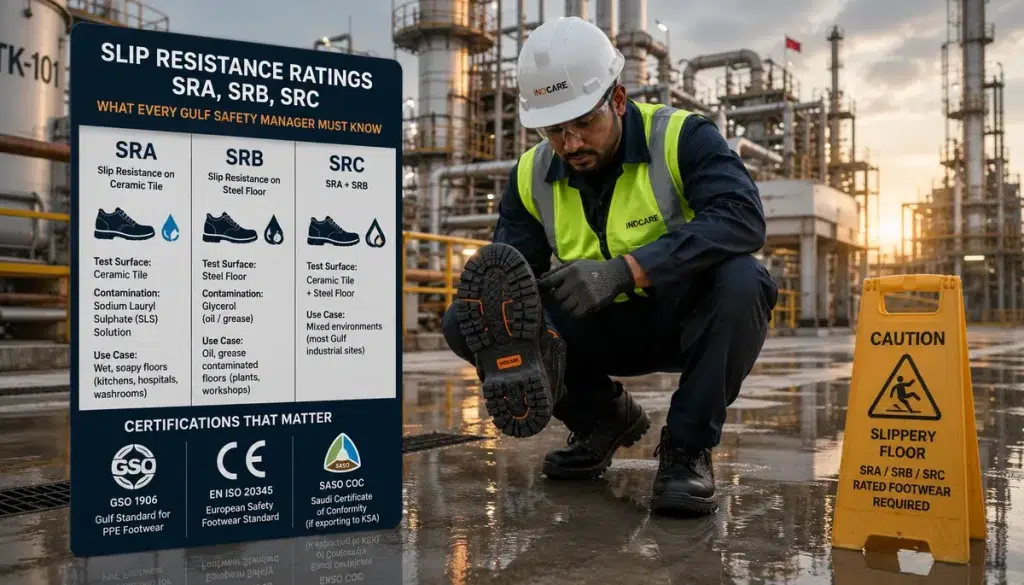
Slip, trip, and fall incidents are the leading cause of workplace injury across all industries. Yet when Gulf safety managers specify footwear, many focus on toe protection and treat outsole grip as secondary. Slip resistance ratings — SRA, SRB, and SRC — are standardised, tested, and meaningful. This article explains what they mean and why they matter for Gulf industrial environments.
Why “Non-Slip” Labels Mean Nothing
Safety equipment markets across Dubai, Riyadh, and Muscat are full of products labelled “non-slip,” “anti-skid,” or “slip-resistant.” These are marketing terms — they carry no standard, no test methodology, and no minimum performance threshold. A shoe labelled “non-slip” without EN ISO 20345 testing may provide no more grip than any other shoe.
SRA, SRB, and SRC are different. They are defined test methods with specific surface conditions, contamination types, and pass/fail thresholds. When a shoe carries SRC, it has passed both defined laboratory tests.
The Three Ratings Explained
Which Rating Do You Need?
| Work Environment | Floor Condition | Rating |
|---|---|---|
| Construction sites | Concrete, water, debris | SRC minimum |
| Oil and gas facilities | Steel/concrete, oil/grease | SRC (SRB critical) |
| Food processing | Wet tiles, fats/soapy residues | SRC (SRA critical) |
| Warehousing/logistics | Smooth concrete, spills | SRC |
| Marine/port operations | Steel grating, seawater | SRC |
| Hospital/healthcare | Polished tiles, wet floors | SRC (SRA critical) |
| Petrochemical | Concrete/steel, chemicals | SRC |
What Else Affects Grip
Outsole compound: Softer rubber provides better grip but wears faster. Cheap shoes use hard compounds that pass the lab test on a new shoe but lose grip quickly. Always ask for the outsole compound specification.
Tread pattern: Wide lugs, drainage channels, and sharp lug edges all contribute to grip. Shallow or clogged tread provides significantly less slip resistance than the rated value.
Purchasing Guidance for Gulf Safety Managers
- Identify floor surfaces and contamination types by work zone
- Default to SRC for any mixed or uncertain environment
- Verify the SRC rating is on the actual shoe label — not just in the marketing brochure
- Ask for the test certificate (not just the label claim)
- Set an outsole wear inspection schedule — minimum tread depth threshold triggers replacement
- Specify anti-fatigue insoles for roles with extended standing — fatigue increases slip-fall risk
Conclusion
SRA, SRB, and SRC are the tested performance indicators that determine whether a shoe actually protects a worker on a wet or oily surface. In the Gulf — where humidity, oily petrochemical environments, and wet food processing floors are daily realities — slip resistance is a critical specification, not an optional extra. Specify SRC. Verify the label. Check the outsole compound. Replace worn shoes before tread depth drops below a safe threshold.