
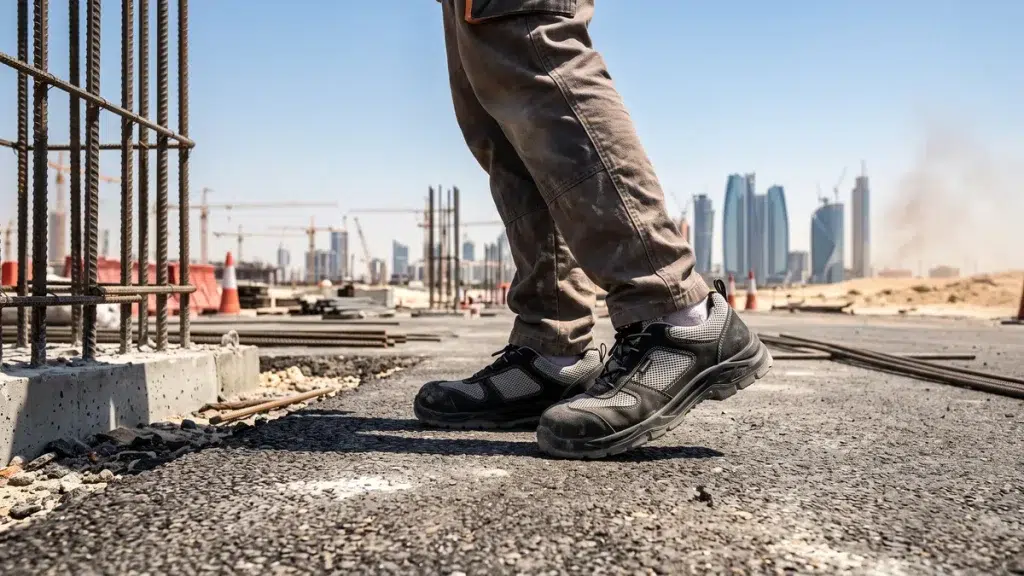
In July and August across the Gulf, air temperature regularly exceeds 45°C and surface temperatures on exposed concrete, steel decking and asphalt climb far higher. A worker standing on that surface is not just working in the heat — they are conducting it, through the sole of their boot, for the length of a shift.
Heat stress guidance in the region concentrates, correctly, on hydration, shade, rest cycles and the midday work restrictions that several Gulf states enforce through the hottest months. Footwear rarely enters the conversation. That is a gap, because the feet are where a significant portion of the body’s heat load enters and where very little of it escapes.
This article looks at what heat actually does inside a safety boot, what the regional regulations mean in practice, and how to specify footwear that does not make a hot job hotter.
How Heat Reaches the Foot
Three mechanisms operate at once, and they need different solutions.
Conduction through the sole
Heat travels from the hot surface into the outsole, through the midsole, and into the footbed. The rate depends on the material and the thickness of the sole complex. This is the mechanism that matters most for workers standing on hot asphalt, roofing membrane, or sun-exposed steel.
Thin, single-density soles conduct heat quickly. A thicker dual-density construction with a lower-conductivity midsole slows the transfer meaningfully.
Radiant and ambient heat into the upper
Dark leather and synthetic uppers absorb solar radiation. A black boot in direct Gulf sun reaches a surface temperature well above air temperature. That heat transfers inward, and because most safety footwear is designed to keep things out, it does not easily transfer back.
Metabolic heat and moisture trapped inside
This is the one most people underestimate. The foot has a very high concentration of sweat glands. In heat, they work hard, and inside a closed boot that moisture has nowhere to go.
The result is a saturated microclimate. Wet skin softens, friction increases, and the insulating layer of damp material around the foot actually makes cooling harder. Workers describe this as boots that feel like they are “cooking” — an accurate description of what is happening.
What Excessive Foot Heat Actually Causes
These are not comfort complaints. They are recognisable occupational health outcomes with cost attached.
- Maceration — skin softened by prolonged moisture, which then tears and breaks down easily
- Fungal infection — warm, damp, enclosed conditions are close to ideal for tinea pedis, which spreads across a workforce sharing facilities
- Blistering — softened skin plus friction produces blisters far faster than dry skin would
- Heat rash across the foot and lower leg
- Increased overall heat strain — the feet cannot shed heat, so the whole body’s thermal load rises
- Reduced grip inside the boot — a sliding foot inside wet footwear causes stumbles independent of outsole grip
There is also a compliance consequence, and it is the most important one. Workers who find their footwear intolerable in summer will modify it. Heels get slipped off during any pause, laces stay loose, and in some cases boots get swapped for personal shoes out of sight of a supervisor. Protection you have paid for stops being protection.
The Regional Regulatory Picture
Several Gulf states restrict outdoor work during the hottest part of the day through the peak summer months. The UAE’s midday break rule is the most widely known, and Saudi Arabia, Qatar, Oman, Kuwait and Bahrain operate comparable restrictions, with the exact hours and dates set by the relevant labour authority each year.
The pattern is broadly consistent: outdoor work is prohibited during a defined afternoon window across the summer months, with exemptions for specific critical activities.
Two things follow for footwear procurement.
First, the restriction shifts work into early morning and evening, which means longer continuous wear across two shift blocks rather than one. Boots get worn for more hours per day, not fewer.
Second, and more subtly, the existence of a legal midday restriction is an official acknowledgement that heat is a workplace hazard requiring control measures. PPE that worsens heat load sits awkwardly against that. Inspectors increasingly look at the whole heat-management picture, not just whether work stopped at the right time.
Specifying Footwear for Gulf Summer Conditions
The objective is honest: you cannot make a 200-joule safety boot cool. You can make the difference between tolerable and intolerable, and that difference determines whether it gets worn correctly.
Prioritise breathability in the upper
- Perforated full-grain leather, which retains durability while allowing vapour transfer
- Engineered mesh panels on the quarters, away from abrasion-exposed areas
- Moisture-wicking linings that move sweat away from skin rather than holding it
- Lighter upper colours where the work environment permits, to reduce solar absorption
Choose the sole for insulation, not just grip
- Dual-density PU, which insulates better than a thin single-density sole
- Consider the HI marking where workers stand on hot surfaces for extended periods
- Consider HRO where brief contact with hot material is a real risk
- Avoid unnecessarily thin soles chosen purely to reduce weight
Reduce weight, because weight generates heat
Every additional gram costs metabolic energy to lift, thousands of times per shift, and that energy becomes heat. Composite toecaps weigh less than steel and do not conduct heat, which makes them a strong choice for hot outdoor work — with the caveat that they are bulkier, so fit needs checking.
Non-metallic penetration-resistant inserts offer the same advantage: lighter, and they do not conduct heat into the footbed the way a steel plate does.
The Two-Pair Rotation
The single highest-impact intervention costs almost nothing to understand and is almost never implemented.
Issue two pairs per worker for the summer months and rotate them daily.
A saturated boot does not dry overnight in Gulf humidity, particularly in accommodation without air conditioning in the storage area. A worker who puts on damp boots each morning starts the shift already in the conditions that cause maceration and fungal infection.
Rotation gives each pair a full 24 hours to dry. The benefits compound:
- Each pair dries completely between wears, breaking the moisture cycle
- Skin problems drop sharply, which reduces both absence and clinic visits
- Outsole and upper life extends, because materials degrade faster when constantly wet
- Total footwear cost often falls despite buying two pairs, because each lasts substantially longer
- Compliance improves, because the boots are no longer unpleasant to put on
Two pairs at a 60% service-life extension each is cheaper per wear than one pair replaced three times. The arithmetic in our cost of ownership guide applies directly.
Practical Measures Beyond the Footwear Itself
Footwear specification is one lever. These cost little and help materially:
- Provide a ventilated drying area rather than a sealed store — airflow matters more than heat
- Issue moisture-wicking socks and require daily changes; cotton socks hold moisture against skin
- Include foot inspection in routine health checks during summer months
- Allow footwear to be loosened during scheduled rest periods in shaded areas
- Train supervisors to recognise early maceration and fungal signs rather than treating them as complaints
- Never permit shared or reissued footwear without proper sanitisation — fungal infection spreads exactly this way
A Note for Indian Exporters and Buyers
If you manufacture in India and supply into the Gulf, summer performance is a genuine competitive differentiator, and it is one that specification sheets do not capture well.
Buyers in Dubai, Riyadh, Doha and Muscat are not comparing certifications alone — those are table stakes. They are asking whether workers will still be wearing the footwear correctly in August. Breathability, weight, and sole insulation are what answer that question.
Indian manufacturers have a structural advantage here. Domestic conditions across much of India already demand heat and monsoon performance, so footwear developed for Indian industry arrives in the Gulf already suited to the climate — unlike products designed primarily for temperate European conditions. Our pieces on UAE construction standards and SASO requirements in Saudi Arabia cover the compliance side.
Conclusion
Safety footwear in a Gulf summer is a heat-management problem wearing a compliance label. Heat conducts up through the sole, radiates in through the upper, and accumulates inside as trapped moisture — and the last of those three does the most damage while receiving the least attention.
Specify for breathability and sole insulation, cut unnecessary weight, and reserve waterproof construction for work that is genuinely wet. Then implement the two-pair rotation, which does more for foot health than any single specification change.
The measure of whether you got it right is not the certificate in the tender file. It is whether the footwear is still being worn properly, laced and fitted, at four o’clock on an August afternoon.