
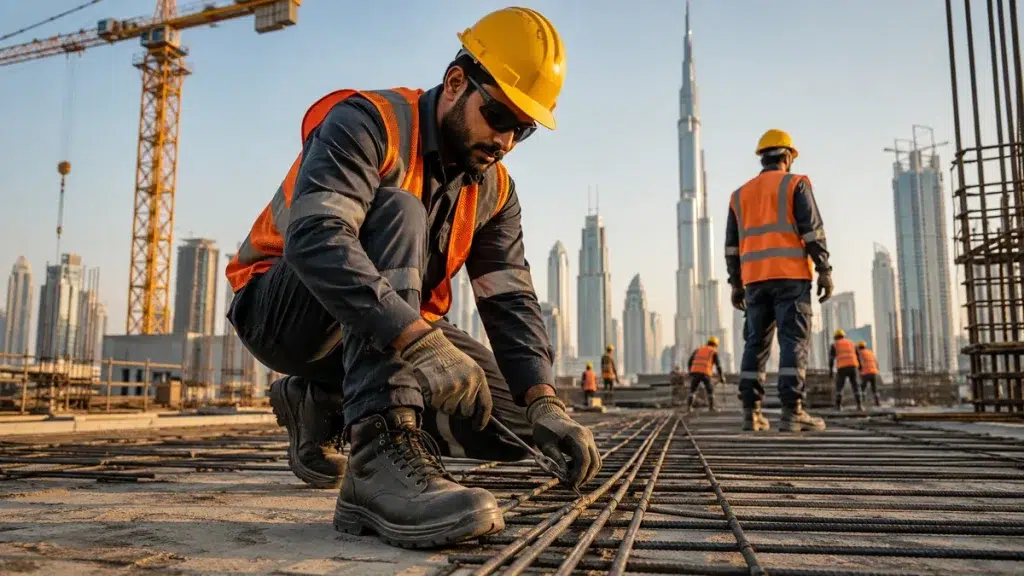
The UAE construction sector is one of the most demanding environments for personal protective equipment in the world. With year-round heat, fast-paced project timelines, and a multinational workforce drawn from India, Pakistan, the Philippines, and across Africa and Asia, the pressure on site safety managers is immense. At the center of that conversation is safety footwear — a piece of PPE that is often sourced without enough scrutiny.
This article explains what the UAE and broader Gulf region actually require from safety shoes in construction environments, and why procurement decisions should start with certified quality rather than price alone.
The Regulatory Framework in the UAE
The UAE does not operate in isolation when it comes to occupational safety standards. The country aligns closely with international frameworks, and construction safety is governed by a combination of federal regulations and emirate-level mandates.
Key bodies and standards relevant to safety footwear in the UAE include:
- UAE Federal Law No. 8 of 1980 (Labour Law) — mandates that employers provide appropriate personal protective equipment to all workers
- Ministerial Resolution No. 32 of 1982 — specifies general health and safety obligations for industrial workplaces
- OSHAD SF (Abu Dhabi Occupational Safety and Health System Framework) — Abu Dhabi’s detailed framework, widely adopted as a benchmark
- Dubai Municipality and Trakhees (JAFZA) — both require documented PPE compliance on construction sites
When it comes to safety shoes specifically, UAE sites typically reference either EN ISO 20345 (the European standard) or ANSI/ASTM F2413 (the North American standard). EN ISO 20345 is more commonly specified across Gulf projects, particularly those run by European or multinational contractors.
What EN ISO 20345 Actually Requires
EN ISO 20345 is the benchmark safety footwear standard in the Gulf. Here is what it demands:
| Requirement | Minimum Standard |
|---|---|
| Toe protection (impact) | 200 joules |
| Toe protection (compression) | 15 kN |
| Slip resistance | SRA or SRB or SRC |
| Penetration resistance | Steel or composite midsole |
| Upper material | Leather or synthetic — heat resistance tested |
| Labelling | Must carry “S” designation (S1, S2, S3 etc.) |
The “S” classification matters enormously:
- S1 — basic toe cap + anti-static + energy absorption at heel
- S2 — S1 + water resistance
- S3 — S2 + penetration-resistant midsole (most common on construction sites)
- SB — basic (steel toe only, no additional requirements)
Most UAE construction projects specify S3 minimum for general construction workers, with S3 + heat resistance (HRO) for workers near welding, cutting, or asphalt-laying operations.
Why Indian Safety Footwear Qualifies for Gulf Markets
India’s national standard for safety footwear — IS:15298 — was harmonised with EN ISO 20345 in its latest revision. Shoes manufactured to IS:15298 Part 2 or Part 3 meet the core structural and protection requirements that Gulf sites are looking for.
Indcare safety shoes by Mittal Safety Works Private Ltd are manufactured at our facility in Mangolpuri Industrial Area, New Delhi, and produced under ISO 9001:2015 and ISO 14001:2015 quality management systems. Our safety shoes meet BIS (Bureau of Indian Standards) certification requirements — the Indian equivalent of EN ISO 20345 compliance.
This means when a UAE procurement manager asks “Is this shoe certified?”, the answer from Indcare is yes — with documentation to support it.
The Most Common Hazards on UAE Construction Sites
- Falling objects and compression injuries
High-rise construction in Dubai, Abu Dhabi, and Sharjah involves significant overhead work. A 200-joule steel toe cap is not optional — it is the baseline. - Puncture injuries from reinforced concrete and rebar
Construction sites are littered with steel rods, nails, and sharp debris. A penetration-resistant midsole (S3 classification) is mandatory. - Slip hazards on wet or oily surfaces
Concrete curing areas, material laydown zones, and early-morning condensation on hard floors all create slip risk. SRC-rated soles address multi-surface slip resistance. - Heat and UV exposure
The UAE sees ambient temperatures exceeding 45°C in summer. The outsole compound must retain its anti-slip and structural properties in high-heat environments. - Chemical and cement exposure
Cement and bonding agents are alkaline and can degrade poorly made outsoles rapidly. Quality PU soles with proper compounding resist hydrolysis and alkaline degradation.
What to Look for When Sourcing for UAE Projects
Check for these on the product label and datasheet:
- EN ISO 20345 or IS:15298 certification number (not just a logo — a certificate number)
- S3 classification as a minimum
- SRC slip resistance rating
- Steel or composite penetration-resistant midsole
- Heat-resistant outsole (HRO) if near asphalt, welding, or furnace work
- Manufacturer’s ISO quality certification
Questions to ask your supplier:
- Can you provide BIS/EN ISO 20345 test reports from an accredited lab?
- What is the outsole compound, and what is its temperature resistance rating?
- What is your warranty or expected life for the shoe in a high-wear UAE environment?
Indcare Products Suited for UAE Construction
Indcare’s PU safety shoe range is built with dual-density polyurethane outsoles that maintain slip resistance in heat, resist alkaline degradation from cement, and provide energy absorption at the heel — all critical for workers standing on hard surfaces for 10–12 hour shifts.
Our steel toe variants carry the standard 200J impact and 15kN compression protection required for EN ISO 20345 compliance, with penetration-resistant midsoles standard in our S3-equivalent construction range.
We supply to dealers, distributors, and project procurement offices. Bulk orders with documentation packages (certificates, test reports, product datasheets) are available on request.
Partnering with Indcare for Gulf Procurement
Mittal Safety Works has been manufacturing safety footwear in India since 2014. We understand the documentation requirements for Gulf-based procurement teams — Labour Ministry approvals, HSE site audits, and contractor-specified PPE compliance sheets.
Our export team can provide:
- Product certificates and test reports
- BIS compliance documentation
- Customised labelling for project or employer branding
- Bulk supply with consistent quality across production runs
Conclusion
The UAE construction sector does not compromise on PPE quality — and neither should the footwear you send to site. EN ISO 20345 S3 is the effective baseline, and sourcing from a certified Indian manufacturer with proper documentation eliminates compliance risk.
If you are sourcing safety footwear for a UAE construction project or managing a Gulf distributor network, Indcare safety shoes deliver the certification trail, the quality, and the competitive pricing that makes Indian manufacturing a smart choice for Gulf markets.