
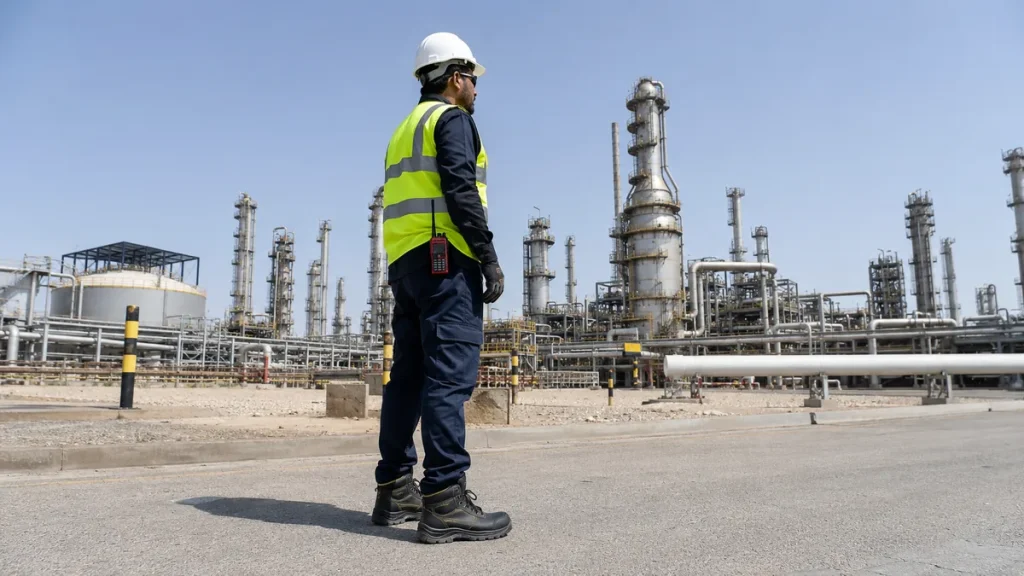
Saudi Arabia is the largest economy in the Gulf region and home to one of the most active industrial sectors in the world. The petrochemical, construction, manufacturing, and logistics industries employ millions of workers — the majority of them expatriate labour from India, Pakistan, Bangladesh, and the Philippines.
For Indian safety footwear manufacturers and Gulf-based importers, Saudi Arabia represents a significant opportunity. But getting the compliance side right is non-negotiable. This article covers what SASO standards actually require, how Indian products qualify, and what documentation an importer needs before the first container clears customs.
The Saudi Standards Authority (SASO)
SASO — Saudi Standards, Metrology and Quality Organization is the national body responsible for developing and enforcing standards in Saudi Arabia. For personal protective equipment including safety footwear, SASO has adopted a combination of local standards and internationally harmonised specifications.
Key SASO regulations relevant to safety footwear:
- SASO 1048 — Saudi standard for safety shoes, historically based on BS 1870 and BS EN 345
- GSO 1906 — Gulf Standards Organization standard for PPE footwear, harmonised with EN ISO 20345:2011
- SASO COC (Certificate of Conformity) — mandatory for PPE imports into Saudi Arabia
In practice, Saudi Arabia requires GSO 1906 compliance for safety footwear entering the market, with a SASO Certificate of Conformity issued through an accredited certification body.
What GSO 1906 Requires
GSO 1906 aligns closely with EN ISO 20345, the European safety footwear standard. This is important for Indian manufacturers because IS:15298 (India’s national standard) was itself harmonised with EN ISO 20345.
| Test Parameter | Requirement |
|---|---|
| Toe protection impact | 200 joules |
| Toe protection compression | 15 kN |
| Slip resistance | SRA (ceramic/SLS) and/or SRB (steel/glycerol) |
| Energy absorption at heel | ≥ 20 J |
| Anti-static property | ≥ 100 kΩ, ≤ 1000 MΩ |
The SASO COC Process
Before safety footwear can be legally sold in Saudi Arabia, the importer must obtain a SASO Certificate of Conformity for each product or product family.
- Select an accredited certification body — SGS, Bureau Veritas, Intertek, TÜV SÜD and others are approved by SASO
- Product testing — samples are tested against GSO 1906 requirements at an accredited lab
- Factory audit — the certification body may conduct an on-site audit for some categories
- Issue of COC — certificate issued per shipment or per product model once testing passes
- Customs clearance — the COC number is required at Saudi customs for goods to clear
Indian Safety Footwear and the Saudi Market
India is well-positioned to supply the Saudi market for several reasons:
- Standards alignment — IS:15298 aligns with EN ISO 20345, which aligns with GSO 1906. The gap is primarily the COC process, not product re-engineering.
- Cost competitiveness — Indian manufacturing costs allow pricing competitive against Chinese, European, and Southeast Asian alternatives.
- Expatriate workforce familiarity — a substantial share of Saudi Arabia’s industrial workforce originates from India. Brand familiarity carries real advantage.
- Supply chain proximity — shorter lead times and lower freight costs compared to European or Far East suppliers.
Key Industries Driving Demand in Saudi Arabia
These facilities specify EN ISO 20345 S3 minimum, with many sites requiring HRO (heat-resistant outsole), ESD (electrostatic dissipative), and chemical-resistant uppers.
Saudi Arabia’s infrastructure programme has generated massive demand for construction PPE. S3 rated shoes with penetration-resistant midsoles are the baseline specification on major project sites.
The Kingdom’s industrial development areas host thousands of manufacturing units requiring standardised safety footwear across all production roles.
Saudi Arabia’s logistics expansion is driving demand for lighter S1 and S2 rated shoes suitable for warehouse environments with long-shift standing requirements.
What Importers Should Ask Their Indian Supplier
- Do you have IS:15298 BIS certification? Get the certificate number — not just the claim
- Have products been tested by an internationally accredited lab? Prior EN ISO 20345 reports accelerate the SASO COC application
- What is your ISO 9001 certification status? ISO-certified manufacturers reduce audit friction on SASO COC routes
- Can you provide consistent quality across large production runs? Gulf projects require re-orders months after initial supply
- Can you support COC documentation requirements? Including product samples, datasheets, and factory inspection participation
Indcare Safety Shoes: Ready for Gulf Distribution
Mittal Safety Works Private Ltd manufactures Indcare safety shoes in Delhi under ISO 9001:2015 and ISO 14001:2015 quality management systems. Our products carry BIS certification to IS:15298 — the internationally harmonised Indian standard.
We work with Gulf-based distributors and importers who supply to industrial projects, construction contractors, and corporate safety procurement programmes across Saudi Arabia and the wider GCC region.
- Complete product documentation packages
- Consistent quality across production batches
- Competitive pricing for bulk orders
- Customised labelling as required
Conclusion
Saudi Arabia’s industrial growth story — driven by Vision 2030 and a massive expatriate workforce — makes it one of the most important markets for safety footwear in the world. For Indian manufacturers like Mittal Safety Works, the alignment between IS:15298 and GSO 1906 means the path to Saudi market entry is clearer than it might seem — provided the documentation is in order.