
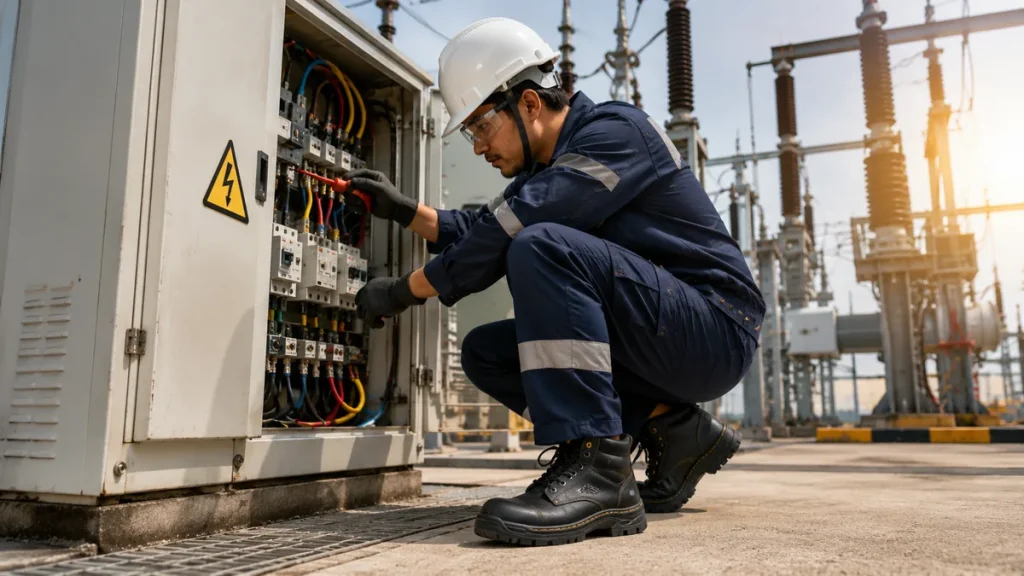
India’s power sector employs hundreds of thousands of workers — from coal-fired plant operators and hydroelectric dam maintenance crews to the teams building out India’s rapidly expanding renewable energy infrastructure. For many of these workers, the ground beneath their feet is the last line of defence against a potentially fatal electrical contact.
This article explains the three types of electrical protection in safety footwear — EH, ESD, and anti-static — what each means, and how to match the right specification to the right workplace.
The Three Types of Electrical Protection in Safety Shoes
These three designations protect against fundamentally different hazards and are frequently confused with each other.
Electrical Hazards in Indian Industrial Workplaces
India’s CEA reports thousands of electrical accidents annually. Workers handling instrumentation and maintenance near live systems need EH-rated footwear as a baseline requirement.
With India’s national grid expanding rapidly, the number of workers in substation construction and transformer installation is growing fast. EH footwear is mandatory in these environments.
EV manufacturing carries both anti-static and EH requirements in different floor zones — particularly near high-voltage battery systems and charging infrastructure.
India’s growing electronics sector requires ESD footwear for all assembly and test floor personnel to protect product quality and prevent catastrophic component damage.
Choosing the Right Electrical Protection
Use this simple decision framework to specify the correct footwear for each role:
- Worker near live circuits? → EH-rated or IS:4770 insulating footwear. Consult your electrical engineer for the correct voltage class.
- Flammable gases or vapours present? → Anti-static (S1/S2/S3 with AS — standard in IS:15298 classified shoes).
- Handling sensitive electronic components? → ESD footwear (resistance under 35 MΩ).
- None of the above? → Standard IS:15298 S1/S2 as appropriate to other workplace hazards.
Common Mistakes Safety Managers Make
- Assuming all safety shoes provide electrical protection — they do not. A steel toe shoe with no electrical rating offers zero protection against live circuits. Steel toe caps can make contact with exposed conductors more dangerous.
- Mixing up anti-static and EH — anti-static prevents sparks from static buildup; EH prevents electrocution from external circuits. Specifying anti-static shoes for live-circuit workers is a dangerous error.
- Wearing EH shoes in wet conditions — EH shoes lose their insulating properties when wet. Outdoor substation workers need additional protective measures beyond footwear.
- Not communicating sole replacement rules — a resoled EH shoe using non-rated sole material has lost its EH certification entirely. Workers and supervisors must understand this.
Indcare Safety Shoes for Electrical Environments
Indcare’s safety shoe range includes S1, S2, and S3 classified shoes that meet the anti-static requirements of IS:15298 as standard. For industrial clients with specific ESD requirements, our team can advise on product selection and provide technical datasheets for procurement approval processes.
Our manufacturing facility operates under ISO 9001:2015 quality management certification, and all products carry BIS certification to IS:15298.
Conclusion
Electrical hazard safety footwear is a specialised category where the consequences of getting the specification wrong can be fatal. Understanding the difference between EH, anti-static, and ESD is essential for any safety manager procuring footwear for workers in power, electronics, or chemical environments.
Match your PPE specification to the actual hazard. When in doubt, consult your electrical safety engineer before specifying footwear for live-circuit environments.