
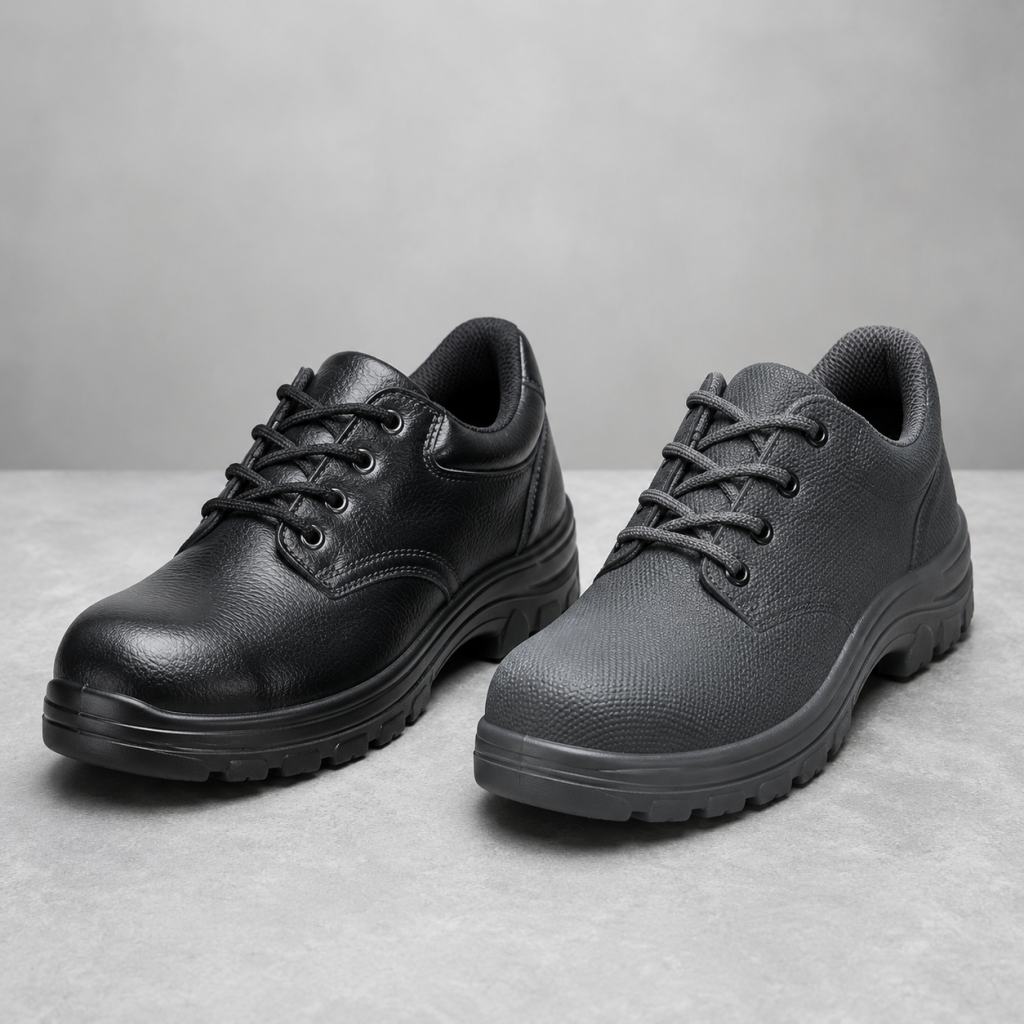
When Indian procurement managers and safety officers are specifying safety footwear for their workforce, one question comes up more than any other: should we go with PU or PVC? It sounds simple, but the answer has significant implications for worker comfort, compliance, operational cost, and service life. This guide gives you the full picture so you can make the right specification for every environment in your facility.
What Are PU and PVC in Safety Footwear?
Both PU (polyurethane) and PVC (polyvinyl chloride) are the primary materials used in safety shoe soles and uppers. They are fundamentally different compounds with different properties, different manufacturing processes, and different performance profiles. Neither is universally superior — each is correct for specific environments.
PU (Polyurethane) is a foam-like compound that can be moulded directly onto the upper in a single injection process. It is lightweight, cushioning-rich, and provides excellent shock absorption. It is the material of choice for dry industrial environments where worker comfort over long shifts is a priority.
PVC (Polyvinyl Chloride) is a harder, denser compound. Safety shoes and gumboots made from PVC are fully waterproof, highly resistant to chemicals including acids, alkalis and solvents, and extremely durable in wet conditions. The trade-off is that PVC is heavier and offers less cushioning than PU.
Full Property Comparison
| Property | PU Safety Shoes | PVC Safety Shoes |
|---|---|---|
| Weight | Lightweight — typically 600–750g per shoe | Heavier — typically 800–950g per shoe |
| Cushioning and shock absorption | Excellent — multi-density PU absorbs impact effectively | Moderate — solid PVC offers less energy return |
| Waterproofing | Resistant with treated upper; not inherently waterproof | Fully waterproof — PVC upper and sole are one sealed unit |
| Chemical resistance | Oil and fuel resistant; limited acid/alkali resistance | Excellent — resists acids, alkalis, solvents, disinfectants |
| Anti-slip performance | SRB rated on most models; oil-resistant tread | SRB rated; performs well on wet ceramic and concrete |
| Durability in abrasive environments | Double-density models (Rock DD PU) extend life significantly | Consistent — PVC is hard-wearing and resists abrasion |
| Breathability | Better — PU foam allows some moisture vapour movement | Lower — PVC is non-breathable; suited for short exposure |
| Cost | Mid to higher range — Indcare PU models from entry to premium | Lower to mid range — cost-effective for wet environments |
Industry-Wise Recommendation Matrix
| Industry / Environment | Recommended Type | Suggested Model |
|---|---|---|
| Manufacturing — dry floors, general use | PU | Hawk PU |
| Engineering and fabrication | PU (double density) | Rock DD PU |
| Automobile — assembly lines | PU | Jumbo Z+ PU |
| Chemical processing | PVC | Caliber PVC / Ranger PVC |
| Food processing — wet floors | PVC | Polo PVC |
| Construction — monsoon / outdoor | PVC Gumboot | Jungle Boot PVC |
| Logistics and warehousing — dry | PU | LS-01 PU / Hawk PU |
| Logistics and warehousing — wet dock | PVC | Polo PVC / Hillman PVC |
| Pharmaceuticals — production floor | PVC (anti-static option) | Caliber PVC |
Monsoon Considerations
During India’s monsoon season — June to September — the choice between PU and PVC becomes particularly important. Workers in outdoor or semi-outdoor environments face regular waterlogging, and a PU safety shoe without adequate waterproofing treatment provides minimal protection once water breaches the ankle height.
For construction, outdoor manufacturing transit, and logistics loading docks during the monsoon, PVC gumboots or full PVC safety shoes are the correct specification. PU shoes should be reserved for dry indoor environments where the monsoon impact is limited to ingress tracking rather than standing in water.
Cost of Ownership Over 18 Months
The purchase price of a safety shoe is only part of the cost picture. Replacement frequency, sole degradation rate, and compliance exposure all contribute to the real cost per worker per year. In dry manufacturing environments, a quality PU shoe lasts 12–18 months and requires no specialist chemical treatment. In wet chemical environments, PVC is the economical choice because PU soles in acid or alkali environments degrade rapidly and must be replaced far more frequently.
Double-density PU models (Rock DD PU, for example) cost more per pair than single-density versions, but in abrasive fabrication or steel environments, the extended sole life brings the annualised cost per worker below the cheaper alternative. Specify on total cost, not unit cost.
Making the Decision
- Map your floors — identify every zone by whether it is dry, wet, chemical-exposed, or outdoor
- Identify primary hazard — impact, slip, chemical, waterlogging
- Match to material — use the matrix above
- Consider shift length — workers standing 8–12 hours need PU cushioning; short-exposure wet zones can tolerate PVC weight
- Confirm IS:15298 certification — both PU and PVC can be certified; verify BIS licence before ordering
Related Reading
- IS:15298 Explained — The Indian Standard for Safety Footwear
- PVC Gumboots for Industrial Use in India
- Monsoon Season Safety Footwear Guide
- Safety Footwear for Construction Sites in India