
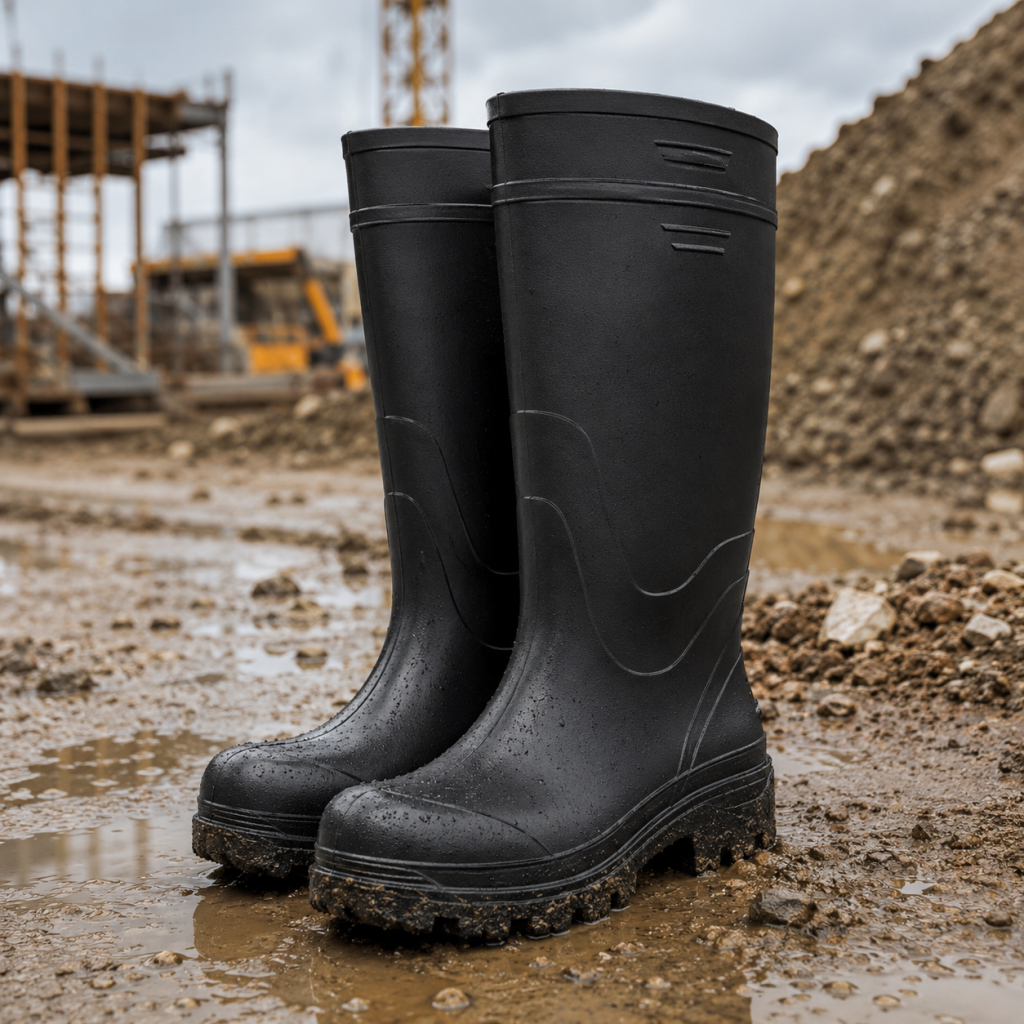
PVC gumboots occupy a specific and essential position in industrial safety footwear. They are not a universal solution — there are environments where PU safety shoes are clearly more appropriate — but in the conditions where gumboots are needed, no other footwear type provides equivalent protection. Understanding when to specify gumboots, which type, and which models addresses a procurement gap that affects thousands of Indian industrial workers annually.
What Makes PVC Gumboots Different
Unlike safety shoes, where the upper and sole are distinct components joined at the welt, a PVC gumboot is a single-piece moulded construction. The upper, shaft, and sole are all PVC — there are no stitched joints, no adhesive bonds, and no seams that can allow water penetration. This makes gumboots uniquely suited for environments where water, mud, chemicals, or other liquids are present at floor level in significant volumes.
The trade-off is comfort and breathability. PVC is non-breathable, and full-shaft gumboots restrict ankle movement. For workers spending entire shifts in gumboots, fit and specification matter — a poorly fitting gumboot creates blisters, restricted circulation, and fatigue that can lead to trips and falls.
Gumboot Types by Application
| Type | Shaft Height | Best For |
|---|---|---|
| Ankle boot (half Wellington) | Ankle height | Light wet-floor environments; short-duration exposure |
| Mid-calf boot | Mid-calf | Moderate waterlogging; most Indian construction uses |
| Knee boot (full Wellington) | Below knee | Deep waterlogging; agricultural use; municipal drainage |
| Steel toe gumboot (IS:15298) | Mid-calf to knee | Industrial use with overhead hazard — required for most factory environments |
Sector-by-Sector Application Guide
Construction Sites
Construction is the primary industrial application for PVC gumboots in India. Foundation workers, outdoor civil workers, and all site workers during the monsoon require gumboots for several reasons: standing water, waterlogged mud, cement alkalinity on wet ground, and reinforcement bar penetration risk. The Jungle Boot PVC is the Indcare specification for construction — it combines a steel toe to IS:15298, anti-slip sole, and mid-calf shaft height suitable for most site waterlogging scenarios.
Food Processing
Food processing facilities with high-pressure washdown routines require footwear that can withstand regular immersion in detergent, disinfectant, and water. Full PVC gumboots are the standard specification in slaughter houses, fish processing, wet dairy operations, and brewery/beverage plant washdown areas. The key specification in food environments is a smooth inner surface for hygiene — avoid gumboots with foam lining in high-bacterial-load environments.
Chemical Plants
In chemical environments, gumboots provide full ankle and lower leg protection against splash — something safety shoes cannot provide above the ankle line. For acid or alkali handling zones, full-shaft PVC gumboots are often the correct specification. Confirm the specific chemical resistance of the PVC compound with the manufacturer for concentrated acid or exotic chemical environments.
Municipal and Utilities
Drainage maintenance, sewage treatment, flood response, and municipal road works during monsoon all require gumboots. The combination of biological contamination, waterlogging, sharp debris, and vehicle hazard in these environments demands IS:15298 steel toe gumboots with adequate shaft height and slip-resistant soles.
When NOT to Use Gumboots
Gumboots are not a universal upgrade. In dry industrial environments, gumboots are heavier and less comfortable than safety shoes, and they restrict ankle movement in ways that increase trip risk on stairs, ramps, and uneven ground. Do not specify gumboots for:
- General dry manufacturing — PU safety shoes are more appropriate
- Office or control room areas — no waterlogging risk, unnecessary weight
- Precision assembly — restricted ankle movement affects fine motor task performance
- High-stair environments — gumboots increase trip risk on metal stairways
Sizing and Fit for Gumboots
Gumboot fit is different from shoe fit. The shaft circumference matters as well as the foot length — workers with wider calves need to confirm shaft fit, not just foot size. Indcare PVC gumboots are available in standard Indian sizes 5 to 12, which covers the adult male industrial workforce. For size-wise bulk ordering, measure the workforce rather than ordering on assumed sizes — the cost of returned or unusable stock is higher than the cost of a measurement exercise.
Related Reading
- PU vs PVC Safety Shoes — Full Comparison
- Monsoon Season Safety Footwear Guide for Indian Workers
- Safety Footwear for Construction Sites in India
- Safety Shoes for Food Processing Facilities
- IS:15298 — What the Standard Requires