
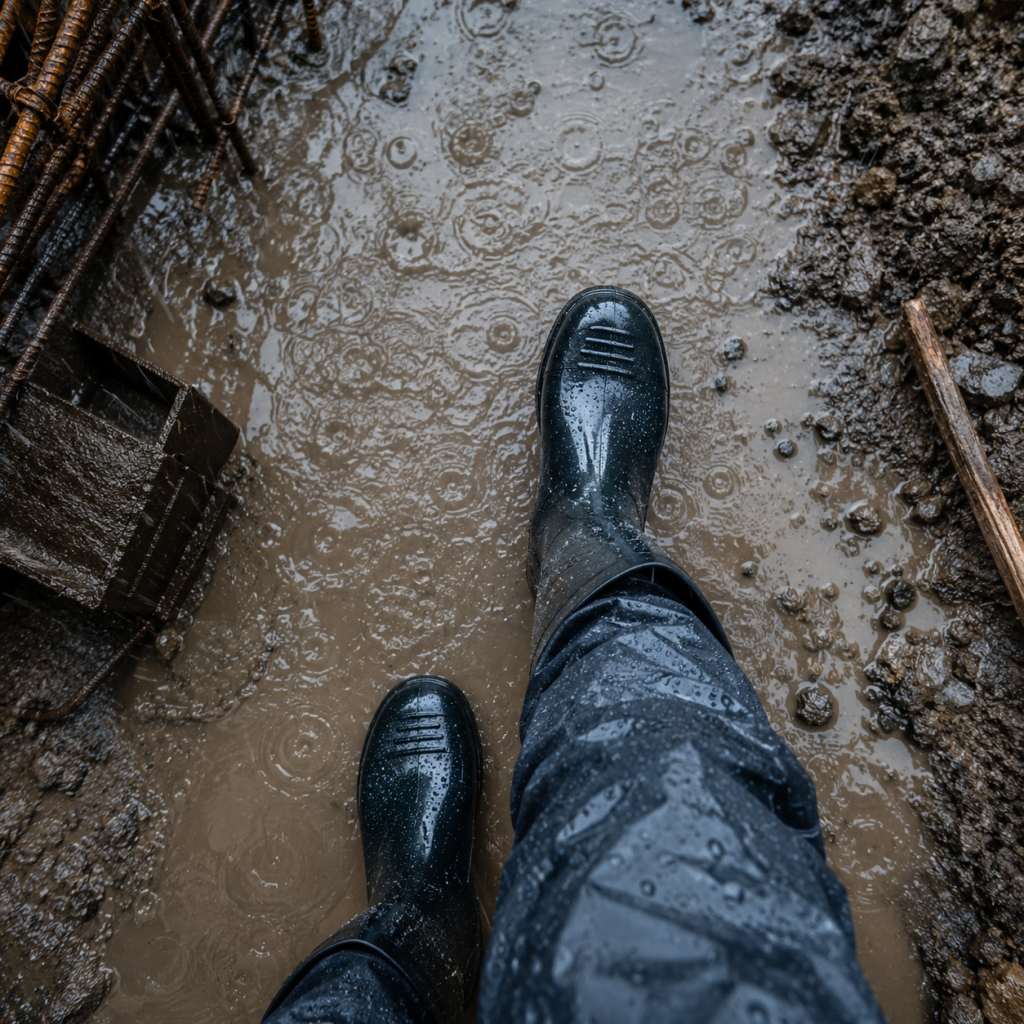
Every year between June and September, India receives the bulk of its annual rainfall. For millions of workers in construction, agriculture, municipal services, and outdoor manufacturing, the monsoon transforms their working environment into one that is significantly more hazardous — and their footwear is often not prepared for it.
How the Monsoon Changes the Hazard Profile
- Waterlogging: Even well-maintained construction sites become flooded. Standard shoes fail above ankle height immediately.
- Slip hazard multiplication: Rain-wet concrete, mud, and saturated soil are far more slippery than dry surfaces.
- Biological hazards: Standing water in urban areas contains drainage overflow and effluent contamination.
- Electrical risk increase: Wet conditions dramatically increase risk near temporary site electrical connections.
Sector-by-Sector Monsoon Footwear Guide
| Sector | Recommendation |
|---|---|
| Construction — outdoor ground workers | Jungle Boot PVC — mandatory during monsoon |
| Agriculture and plantation | Full PVC gumboots |
| Municipal maintenance | Full-height gumboots with sealed construction |
| Outdoor logistics/delivery | Polo PVC at minimum |
| Manufacturing — outdoor areas | Polo PVC or Hector PVC for transitions |
Pre-Monsoon Procurement Planning
The single biggest mistake companies make is not planning ahead. The monsoon is predictable — Kerala by June 1, full coverage by July. Yet companies scramble for stock after the first rains, when suppliers are depleted and lead times are extended.
Recommended timeline: March–April: assess inventory. April–May: place bulk orders. Late May: distribute before first rains.
Contact Mittal Safety Works now to reserve monsoon stock before the season. We offer advance supply scheduling for predictable annual requirements.
Order Monsoon Footwear Contact Sales →
Regional Monsoon Progression — Procurement Timing by State
The Indian monsoon does not arrive everywhere at once. Understanding the regional progression allows procurement teams in multi-site operations to stagger delivery rather than front-loading all stock to a single warehouse.
| Region | Typical Monsoon Onset | Key Industries Affected |
|---|---|---|
| Kerala and coastal Karnataka | Early June | Construction, port logistics, plantations |
| Mumbai, Maharashtra, Goa | Mid-June | Construction, manufacturing, port operations |
| Bengaluru and Tamil Nadu (east) | Late June – Early July | Manufacturing, IT campuses, construction |
| Delhi-NCR, UP, Rajasthan | Early to mid-July | Manufacturing, construction, logistics |
| Punjab, Haryana, Gujarat | Mid to late July | Textiles, food processing, logistics |
| Northeast India | Early June (often earlier) | Tea, agriculture, construction |
Why Monsoon Injuries Spike in July
Insurance industry data consistently shows July as the single riskiest month for workplace injuries in India. This is not primarily because rainfall is highest in July — it is because the combination of worker adaptation fatigue (workers become less cautious about wet surfaces as the novelty of monsoon conditions wears off), equipment degradation (footwear worn into monsoon season without replacement is at its worst condition by mid-season), and cumulative waterlogging (drainage systems become saturated) creates a compounding risk environment.
The implication for procurement: do not wait until July to replace worn monsoon footwear. Conduct a footwear inspection in late June and replace before cumulative degradation compounds slip risk.
The Footwear Inspection Before Monsoon — A Simple Protocol
Every year, the monsoon begins with the previous season’s footwear still in service. A pre-monsoon inspection protocol — conducted in April or May — identifies footwear that will fail within the first four weeks of heavy rain use.
- Tread check — place the shoe on a flat surface. If the heel or ball of the sole is flat, slip resistance is compromised. Replace.
- Sole flex test — bend the shoe at the ball. If the sole shows cracking, delamination, or separation at the welt, replace.
- Toe cap check — press the toe area firmly. If there is flex, the toe cap has been compromised by previous impact. Replace.
- Upper check — look for cracking, splitting, or delamination in the upper material. In PVC shoes, check for hardening or brittleness from UV exposure.
- Anti-slip visual — look at the tread pattern. If it is glazed, polished smooth, or visibly worn flat, the SRB rating is no longer valid. Replace.
Related Reading
- PVC Gumboots for Industrial Use in India
- Anti-Slip Safety Shoes — Slip Resistance Explained
- Safety Footwear for Construction Sites
- Safety Shoes for Logistics and Warehousing
- Monsoon 2026 and Workplace Slip Injuries — Current Statistics