
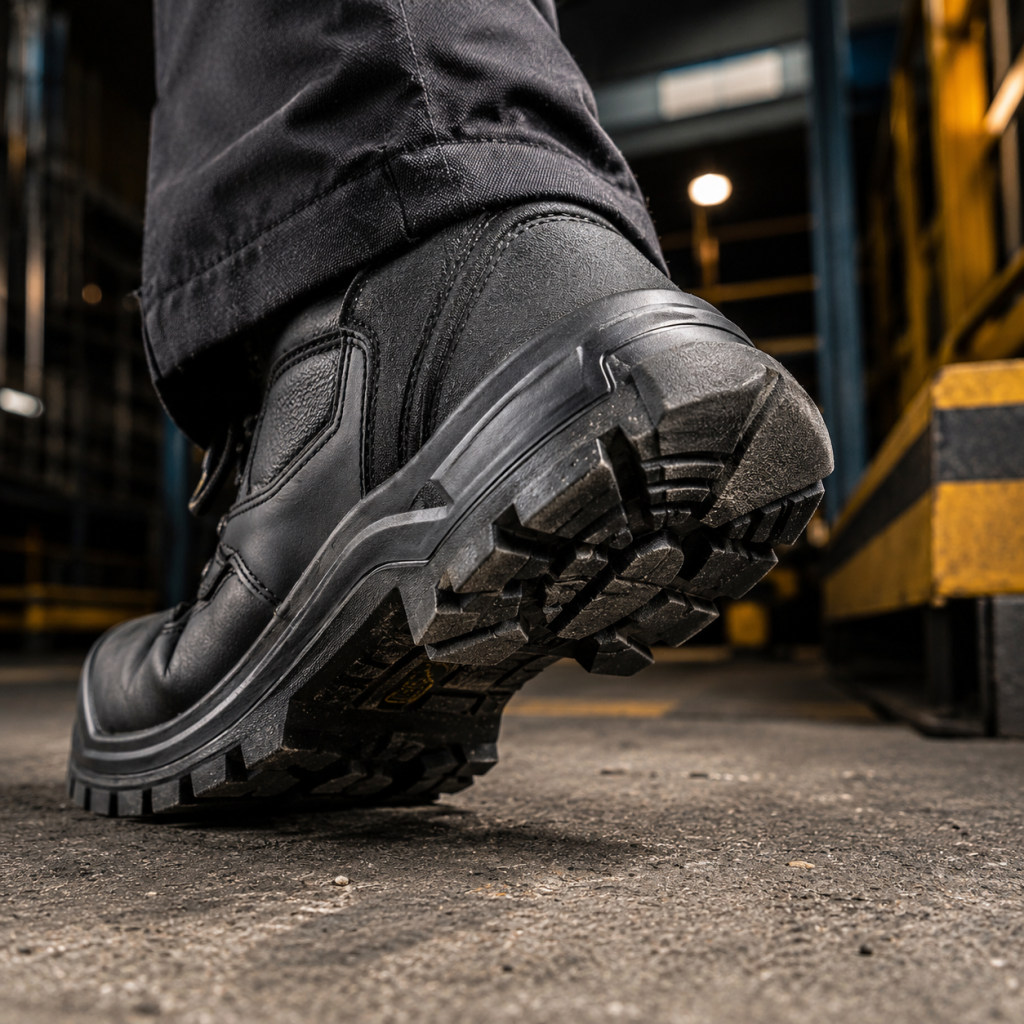
The average industrial worker in India puts in 250 to 300 working days a year. On a factory floor, a construction site, or a warehouse, that means a pair of safety shoes takes roughly 2,000 to 2,500 hours of punishment every year — standing, walking, lifting, climbing, and operating in conditions that most footwear simply was not designed to handle.
At Mittal Safety Works, we build Indcare safety shoes for exactly this kind of use. Not for trade shows. Not for photographs. For the worker who needs footwear that does not quit before the shift does.
Durability Under Industrial Conditions
The most common failure in cheap safety footwear is sole separation — the bond between the upper and the outsole gives way under repeated flex stress. Indcare shoes use a direct moulding process that bonds the sole chemically and mechanically to the upper, rather than relying on adhesive alone. This significantly extends sole life, particularly in environments with temperature variation and chemical exposure.
The Rock PU and Rock DD PU (double-density) are our most specified models for abrasive environments — fabrication yards, stone yards, and heavy construction — where sole wear rate is the primary concern.
Protection That Holds Through a Full Shift
Steel toe caps are only part of the protection story. The anti-slip outsole, the midsole support, and the ankle stability of the shoe all contribute to keeping the wearer safe and functioning through a long shift. A shoe that protects your toes but gives you heel pain by 3pm, or one that slips on an oil patch, has partially failed its purpose.
Indcare PU shoes are designed with a multi-zone approach to protection — the toe cap for impact, the outsole for grip and chemical resistance, and the midsole for sustained comfort under load. The Jumbo Z+ PU uses an enhanced midsole compound specifically for workers who stand on hard floors for extended periods.
Built for the Indian Worker's Foot
Imported safety footwear is frequently sized and lasted on European foot shapes, which tend to be narrower in the forefoot than the typical Indian foot. Ill-fitting safety shoes are not just uncomfortable — they cause blisters, affect posture and gait, and lead to workers removing their footwear during breaks and not putting it back on, which is precisely when accidents happen.
Indcare footwear is lasted on a last developed for the Indian foot — with appropriate forefoot width and toe box height to fit comfortably without pressure points through a full shift.
Value Over the Replacement Cycle
When you evaluate safety footwear cost, the unit price is not the right metric. The right metric is cost per day of use — or cost per working year. Cheap shoes replaced every four months will cost more than quality shoes replaced every fourteen months, and they will cause more foot injuries in the process.
Mittal Safety Works offers Indcare safety shoes at competitive bulk pricing, with the quality to last the full specification period. Request a quote with your size breakdown and we will provide per-unit pricing based on your order quantity.
What Our Customers Tell Us
We regularly hear from safety managers at manufacturing companies that switched to Indcare after experiencing high casualty rates with cheaper alternatives. The feedback is consistent: longer replacement cycles, fewer foot complaints from workers, and simpler compliance documentation for audits.
Browse the full Indcare range at our products page, or contact our team to discuss which model suits your specific working environment.
What Durability Means in Practice
Durability in safety footwear is not a single property — it is the sum of several material properties that determine how long the shoe maintains its protective and functional performance under your specific working conditions. Two shoes that look identical may have very different service lives depending on sole compound, upper material, and construction method.
| Durability Factor | What Determines It | Indcare Approach |
|---|---|---|
| Sole abrasion resistance | Rubber or PU compound hardness and composition | IS:15298 tested; double-density available for abrasive environments |
| Sole adhesion to upper | Bonding method — vulcanised, cemented, or direct injection | Direct injection PU moulding — no adhesive bond to fail |
| Upper tear resistance | Material thickness, fibre reinforcement | Tested to IS:15298 minimum 100N tear strength |
| Eyelet pull strength | Metal vs plastic eyelets; attachment method | Tested to IS:15298 minimum 60N per eyelet |
| Toe cap integrity | Steel grade, cap geometry, press tolerance | BIS IS:15298 200J impact tested |
Value Over the Full Replacement Cycle
A shoe that costs Rs 200 more per pair but lasts 4 months longer than the cheaper alternative costs less per month of protection. For a 100-person workforce, this difference compounds significantly over a year. The correct way to evaluate safety footwear cost is annualised cost per worker, not unit purchase price.
Example: Assume Model A costs Rs 1,200 per pair and lasts 10 months. Model B costs Rs 1,500 per pair and lasts 16 months. Model A costs Rs 1,440 per worker per year. Model B costs Rs 1,125 per worker per year. For 100 workers, Model B saves Rs 31,500 annually — despite costing more per pair.
The Direct Injection Difference
Indcare PU safety shoes are produced by direct injection — the PU sole is injected directly onto the upper in a single moulding process. There is no adhesive layer that can delaminate in heat, chemical exposure, or wet conditions. This is a significant durability advantage over cemented constructions where the sole-to-upper bond is the primary failure point.
Related Reading
- How to Extend the Life of Your Safety Shoes
- Safety Shoe Replacement Schedule
- PU vs PVC — Durability Comparison
- IS:15298 — Durability Tests in the Standard