
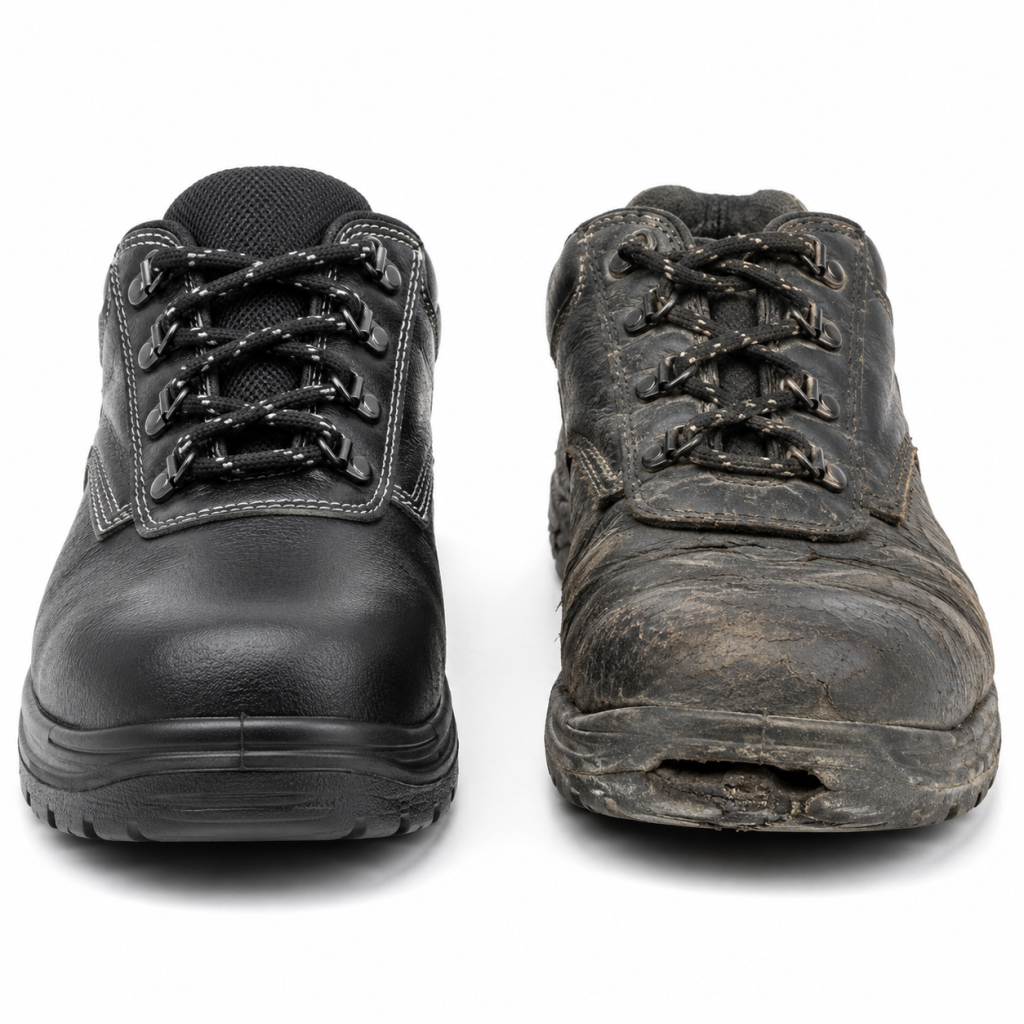
Safety shoes are consumable items with a finite service life. Every parameter that IS:15298 tests — slip resistance, cushioning, sole adhesion, penetration resistance — degrades over time. A shoe that looks intact may have flat soles providing zero slip resistance, or compressed midsoles providing zero cushioning.
Factors Determining Replacement Frequency
- Daily use duration — double-shift workers wear footwear twice as fast
- Floor surface — abrasive floors (grit, metal shavings, stone) wear outsoles faster
- Chemical exposure — accelerates material degradation
- Outdoor vs indoor — UV, temperature extremes, and rain increase degradation
Recommended Replacement Intervals
| Environment | Inspection | Replacement |
|---|---|---|
| General manufacturing (dry) | 6 months | 12–18 months |
| Heavy engineering, fabrication | 4 months | 8–12 months |
| Chemical processing (PVC) | 4 months | 10–14 months |
| Food processing (high washdown) | 3 months | 10–14 months |
| Construction (outdoor) | 4 months | 8–12 months |
| Logistics and warehousing | 6 months | 12 months |
The Inspection Checklist
- Tread depth below 3mm at heel or ball → replace immediately
- Tread pattern glazed or visibly smooth → replace
- Separation at the sole welt → replace
- Toe box flexes easily under hand pressure → replace
- Midsole feels flat — no cushioning recovery → replace
For annual supply arrangements that eliminate end-of-year scrambles, contact our team to discuss supply scheduling.
What IS:15298 Actually Certifies — And Why It Degrades
IS:15298 certification tests the shoe against specific parameters when new — 200J impact at the toe, 15kN compression, SRB slip resistance, outsole abrasion, sole energy absorption. None of these properties are permanent. Every one of them degrades with use. A shoe that passed all IS:15298 tests when manufactured may fail several of them after 12 months of use in an abrasive industrial environment.
This is the fundamental reason why replacement scheduling exists. The BIS certification guarantees the shoe met the standard when it left the factory, not when it is on a worker’s foot two years later.
The Visual Inspection Protocol
Safety managers should conduct a quick physical inspection every time footwear is due for scheduled review. This takes less than 2 minutes per pair and identifies wear that requires replacement before it becomes a safety gap.
| What to Check | Replace If… |
|---|---|
| Heel tread depth | Depth below 3mm — measure with a coin or ruler |
| Ball of foot tread | Tread channels glazed smooth or below 2mm depth |
| Welt adhesion | Any separation between upper and sole at the joint line |
| Toe box integrity | Any visible flex or give when pressed from above — steel cap compromised |
| Midsole cushioning | Shoe feels flat — no spring when pressing heel with thumb |
| Upper material | Cracks, splits, delamination, or holes in the upper |
| Inner lining (PU shoes) | Lining torn or degraded — exposes worker to interior seams and reduced fit |
Industry-Specific Replacement Intervals — Expanded
The intervals in the table above are starting points, not fixed rules. Your actual replacement interval depends on specific factors in your environment:
- Floor abrasiveness — concrete with aggregate, metal scale, grit-contaminated floors wear soles much faster than smooth epoxy or tile
- Shift duration — a worker on a 12-hour shift accumulates wear 50% faster than one on an 8-hour shift on the same floor
- Chemical exposure — acid, alkali and solvent exposure accelerates material degradation even when the shoe appears intact
- Outdoor use — UV exposure, temperature cycling, and rain all degrade PVC and PU materials faster than indoor-only use
- Worker weight — heavier workers exert more compressive force on midsoles, accelerating cushioning compression
Building an Annual Replacement Budget
For finance and procurement teams, safety footwear replacement is a predictable cost that can be budgeted accurately with good data. The inputs needed:
- Number of workers per zone
- Replacement interval per zone (from the table above)
- Current unit cost per model
- Buffer factor — typically 10–15% for new joiners, lost pairs, and early replacements
A manufacturing facility of 100 workers with a 14-month average replacement interval requires approximately 86 pairs per year plus 10–13 pairs buffer — roughly 100 pairs per year. At this volume, an annual supply agreement with Mittal Safety Works provides consistent stock, fixed pricing, and complete documentation without multiple ad-hoc orders.
Related Reading
- How to Extend the Life of Your Safety Shoes
- Anti-Slip Safety Shoes — When Slip Resistance Fails
- IS:15298 — What the Standard Tests
- Safety Footwear Procurement Guide for SMEs