
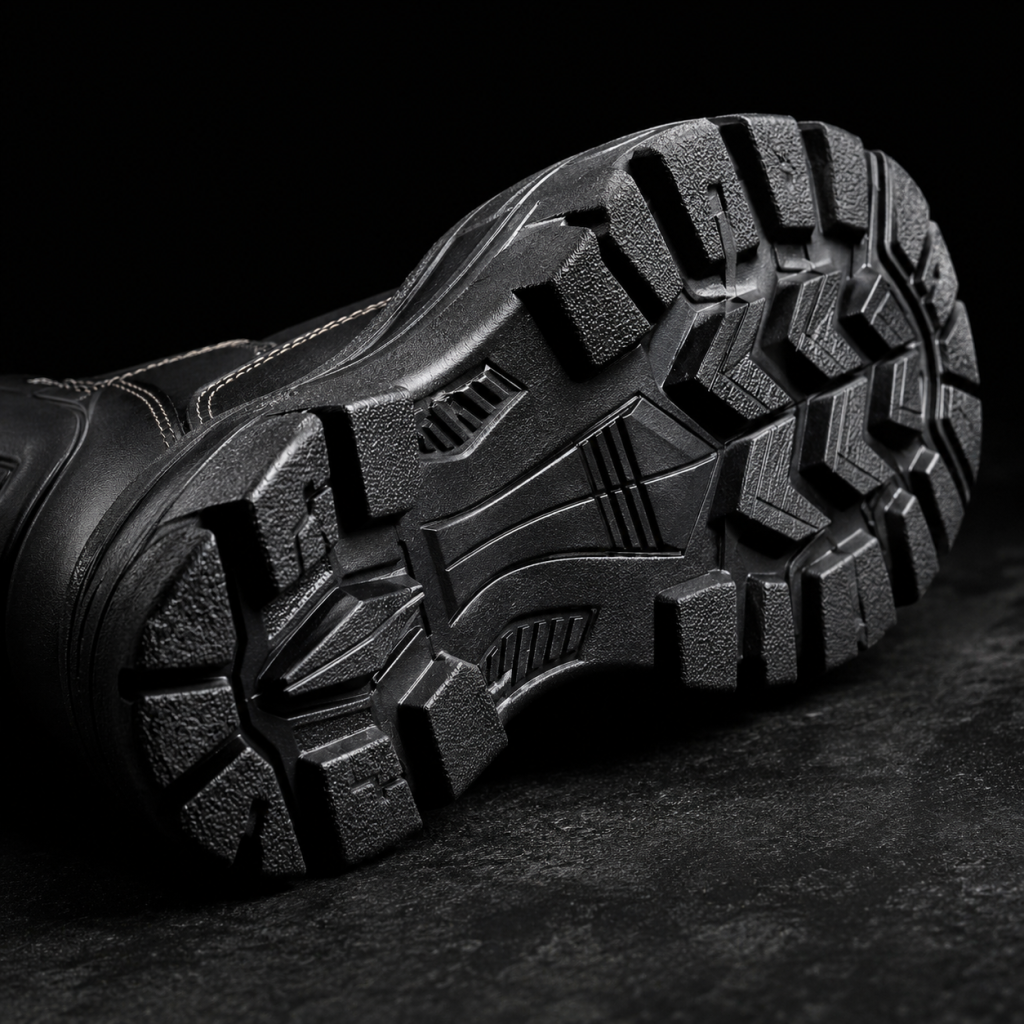
When safety managers evaluate safety footwear, they focus on toe protection. But statistically, the property they are undervaluing is slip resistance. Slip-and-fall accidents are the most common cause of non-fatal occupational injuries in India — more common than falling object injuries.
Understanding Slip Resistance Ratings
| Rating | Test Surface | Relevant Environments |
|---|---|---|
| SRA | Ceramic tile with soap solution | Food processing, hospitals, wet tile |
| SRB | Steel plate with glycerol (oil) | Engineering, manufacturing, auto workshops |
| SRC | Both SRA and SRB | Mixed contamination environments |
Matching Outsole to Your Floor
- Oiled concrete (manufacturing): SRB rating — Hawk PU, Rock PU
- Wet ceramic tile (food/hospitals): SRA rating — Polo PVC, Hector PVC
- Chemical plant floors: SRA + chemical resistance — Polo PVC, Caliber PVC
- Outdoor/construction: Deep lug tread — Jungle Boot PVC
When Anti-Slip Performance Degrades
A common issue is footwear procured with good slip ratings worn until the outsole is flat. Check tread depth every 6 months — replace when below 3mm. A glazed, smooth outsole provides virtually no slip resistance regardless of its original rating.
All Indcare safety shoes are tested for anti-slip performance as part of IS:15298 certification. Request a Bulk Quote
How Slip Resistance Is Tested — The SRB Standard
When a safety shoe carries an SRB rating, it means it has been tested on a ceramic tile surface contaminated with a sodium lauryl sulphate (SLS) surfactant solution — a standardised simulation of soapy or oily wet floor conditions. The test measures the dynamic coefficient of friction (CoF) between the sole and the surface. An SRB rating requires a CoF of at least 0.28 on this surface, which represents the minimum threshold for safe walking on a wet smooth floor.
Some shoes carry an SRC rating, which adds a second test — a steel surface contaminated with glycerol, simulating oily metal floors. For steel plants, fabrication shops and engineering floors, SRC is the more relevant specification.
Why Slip Resistance Degrades and How Fast
The tread pattern on a safety shoe sole is what delivers the slip resistance — it channels liquid away from the contact surface, creating micro-drainage paths that allow the sole to contact the floor directly rather than riding on a film of liquid. As the tread wears down, the drainage channels become shallower and eventually disappear. A shoe that tested SRB when new may provide no meaningful slip resistance at 12 months of use on abrasive floors.
| Environment | Tread Wear Rate | Effective SRB Life |
|---|---|---|
| Office/light duty | Very slow | 3+ years |
| General manufacturing (concrete) | Moderate | 12–18 months |
| Logistics (epoxy/tile floor) | Moderate | 12–18 months |
| Construction (outdoor/rubble) | Fast | 6–10 months |
| Steel/fabrication (metal scale) | Very fast | 4–8 months |
| Food processing (wet tiles, frequent wash) | Moderate–fast | 8–12 months |
Slip Statistics in Indian Industry
The Directorate General Factory Advice Service and Labour Institutes (DGFASLI) consistently identifies slip, trip and fall as one of the top three causes of non-fatal workplace injuries in Indian manufacturing. During the monsoon season (June–September), slip-related injuries spike significantly — workplace insurance data shows the monsoon months account for 43 per cent of all annual workplace injury claims, with wet surface slips as a primary contributing factor.
Specifying Anti-Slip Correctly
- Know your floor surface — dry concrete, wet tile, oily metal and polished epoxy all present different friction challenges. Match the sole compound and tread design to your specific surfaces.
- Confirm the rating — SRB is the minimum Indian industrial standard. For food processing, chemical plants and outdoor construction, SRC or specific sector standards may apply.
- Replace proactively — do not wait for a slip injury to trigger replacement of worn footwear. Set a tread depth trigger (3mm minimum at heel) and inspect quarterly.
- Address the floor as well — footwear anti-slip performs best on clean, regularly maintained floors. Footwear cannot compensate for contaminated or poorly maintained floor surfaces.
Related Reading
- Monsoon Season Safety Footwear — Slip Risk in Wet Conditions
- IS:15298 Explained — Slip Resistance Testing
- Safety Shoe Replacement Schedule — When to Replace
- Safety Shoes for Food Processing — Wet Floor Specification