
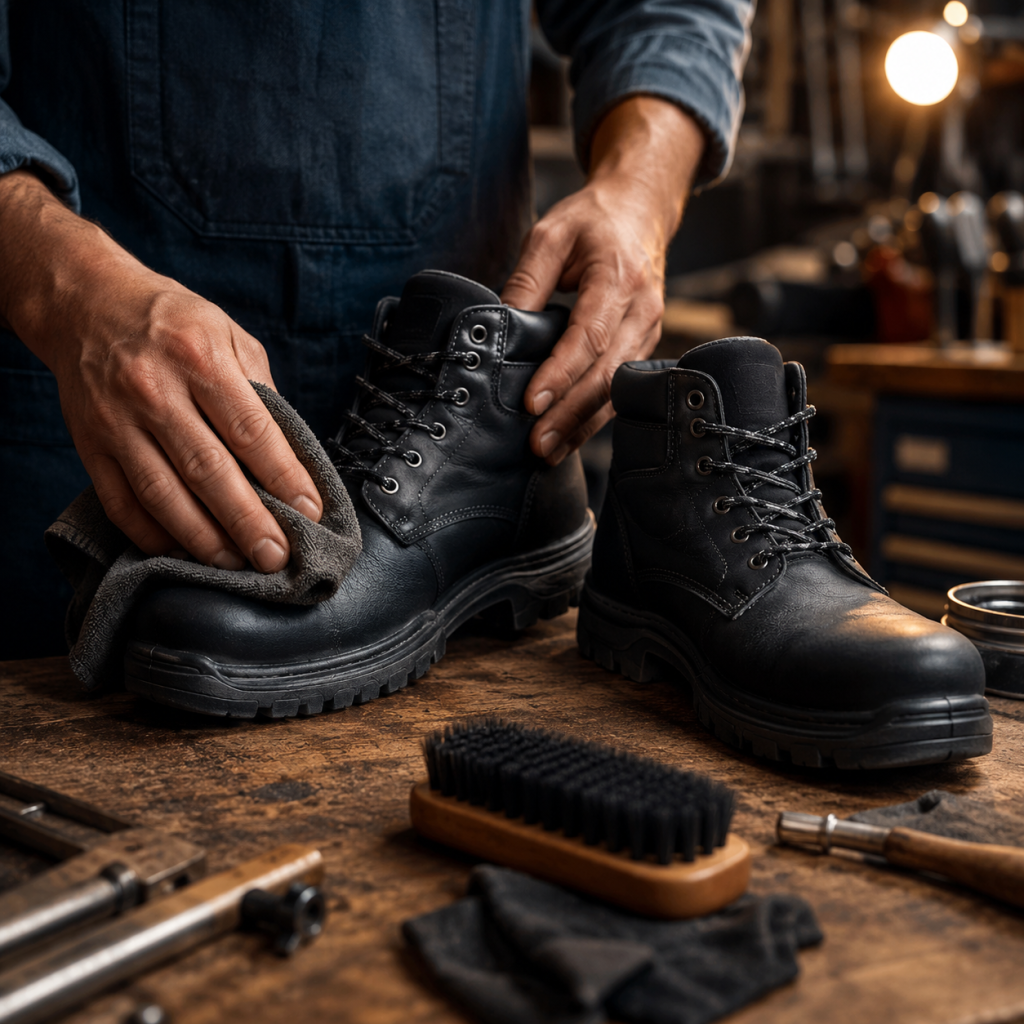
Safety shoes are a significant investment — for individuals, for safety managers, and for companies purchasing footwear for their entire workforce. Getting the most from that investment is not simply about buying a quality pair. It is about how you look after them once they leave the factory.
At Mittal Safety Works, we supply Indcare safety footwear to industries across India — from manufacturing and construction to logistics and chemical processing. We are often asked how long our shoes last. The honest answer is: it depends almost entirely on how they are maintained.
Follow these six practices and your Indcare safety shoes will serve you significantly longer.
1. Clean Them After Every Shift
This sounds obvious, but it is rarely done. Industrial environments deposit oils, metal filings, concrete dust, and chemicals onto your footwear. Left overnight, these contaminants work into the leather or PVC, accelerate degradation, and — in the case of chemicals — can actually attack the sole bonding compound.
For PU shoes (Hawk PU, Rock PU, Jumbo PU): wipe with a damp cloth, remove mud from the sole grooves, and allow to air dry. For PVC Gumboots (Polo PVC, Jungle Boot PVC): rinse under running water, check the ankle for any debris caught in folds, and store upright.
2. Never Dry Them Near Direct Heat
Leaving safety shoes on top of a radiator, near a furnace, or in direct sunlight will dry out and crack the upper material — whether leather, PVC, or synthetic — much faster than normal use. Heat also weakens the adhesive bond between the upper and the sole.
Dry your footwear at room temperature in a well-ventilated area. If they are soaked, stuff them loosely with newspaper to absorb moisture from the inside, and allow 12–16 hours before the next use.
3. Condition Leather Uppers Regularly
For Indcare models with leather uppers, apply a leather conditioner or neutral polish every two to four weeks. This keeps the leather supple, prevents cracking at the flex points, and maintains the water-resistant surface treatment. A cracked leather upper allows water and chemicals inside — shortening the life of the shoe and compromising the wearer's protection.
4. Inspect the Sole and Welt Every Week
Take sixty seconds each week to look at the underside of your shoes. Check for embedded objects (metal shavings, nails, glass), unusual wear patterns, and any separation at the point where the upper meets the sole. Catching a small separation early means it can sometimes be re-bonded; leaving it means the entire shoe is lost.
Also check the sole thickness at the heel. When it drops below 4mm, the anti-slip grooves are essentially gone.
5. Rotate Between Two Pairs If Possible
If your budget and safety policy allows it, rotating between two pairs and allowing each to fully dry and recover between uses can nearly double the effective lifespan of each pair. Midsole foam — which provides the cushioning and absorbs impact — compresses during use and recovers partially during rest. Daily rotation maintains better cushioning performance over time.
For companies purchasing footwear for large workforces, Mittal Safety Works offers bulk pricing that makes two-pair rotation genuinely cost-effective. Request a bulk quote to see per-unit pricing at scale.
6. Replace Insoles Before the Shoe
The insole (footbed) wears out faster than the rest of the shoe. When you start experiencing new heel or arch discomfort, replace the insole rather than the entire shoe. Many Indcare models have removable insoles that accept standard replacement footbeds. This can extend the functional life of a pair by four to six months.
When to Replace Regardless
Even with perfect maintenance, safety shoes should be assessed for replacement every 12–18 months under standard industrial use — or earlier if your environment is particularly harsh (wet, chemical, or abrasive). BIS guidelines require that safety footwear must still meet specification at the time of use. Worn-out shoes that no longer meet standard offer no formal protection.
If you are a procurement manager or safety officer reviewing your footwear replacement schedule, our team at Mittal Safety Works can advise on appropriate replacement cycles for your specific industry and environment. Contact us or view our certifications.
Browse our range — BIS IS:15298 compliant, bulk supply available across India, Gulf and USA.