
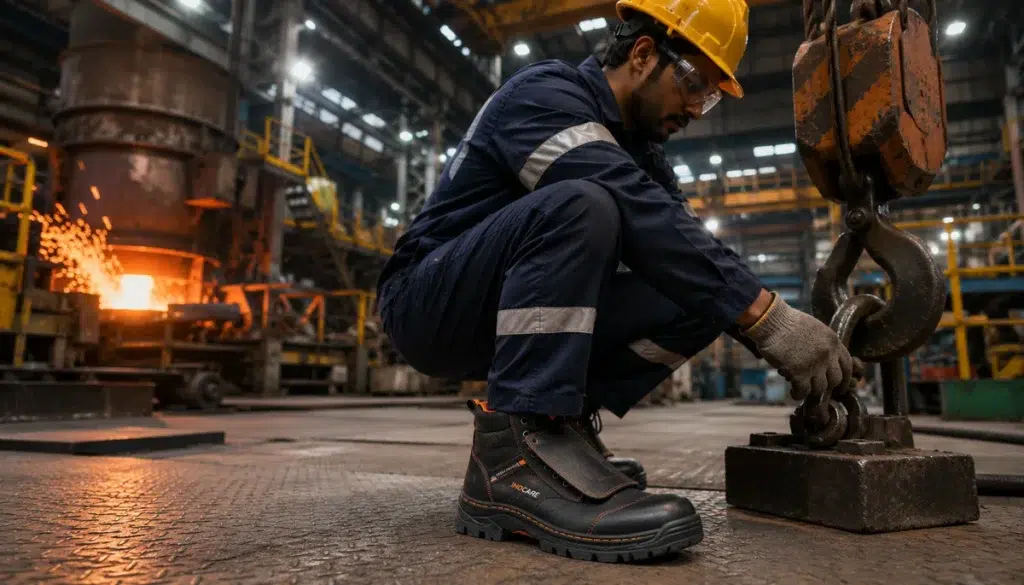
When most people think about safety shoes, they think about the steel toe cap — and for good reason. But the steel toe covers only the toes. The five metatarsal bones — the long bones running from ankle to toes — are left largely unprotected in standard safety footwear. In heavy industry, metatarsal injuries are serious, underreported, and preventable.
Understanding Metatarsal Injuries
A metatarsal fracture is one of the most debilitating workplace foot injuries — recovery takes 6–12 weeks, and healed fractures can create chronic pain and sensitivity. The fifth metatarsal (outer bone, running to the little toe) is the most commonly fractured — it is the most exposed and catches objects landing just outside a standard toe box.
How Metatarsal Injuries Happen
- Dropped objects — a wrench dropped from 1.5 metres generates enough energy to fracture metatarsal bones through a standard shoe upper
- Rolling loads — dollies, drum trolleys, and wheeled carts can overrun the midfoot before a worker can react
- Heavy object placement — components shifting during placement onto jigs can catch the midfoot
- Vehicle proximity — fork trucks and pallet trucks can overrun a foot; the steel toe protects toes but not the metatarsal zone
Industries With Elevated Metatarsal Risk
Constant overhead lifting and component handling creates frequent dropped-object exposure across the full foot, not just the toe zone.
Heavy, hot components create both thermal and mechanical hazards. Standard S3 toe protection is insufficient for full foot coverage.
Underground and surface operations involve irregular heavy objects with limited space to react to falling material.
High-volume assembly lines with heavy components and AGV vehicle traffic create sustained metatarsal exposure.
The M Designation Under IS:15298 / EN ISO 20345
Metatarsal protection is an optional additional feature designated by the code M on the shoe label. An S3 M shoe carries both S3 classification and tested metatarsal impact protection. The test applies defined impact energy to the metatarsal guard — the space behind it must not decrease beyond a defined limit.
Types of Metatarsal Protection
- Internal metatarsal guard — sits inside the upper, no change to external appearance, adds some weight. Most comfortable option for long shifts.
- External metatarsal guard — moulded guard over the instep, provides visible coverage. Common in North American OSHA-influenced specifications.
- Metatarsal spats — strap-on attachments for existing footwear. Practical interim solution but less reliable than integrated protection.
Key Procurement Questions
- Is the M designation on the shoe label? Unlabelled = untested. No exceptions.
- Internal or external guard? Internal preferred for shift comfort.
- Does coverage extend to the 5th metatarsal? The outer bone is the most commonly fractured.
- How does the guard affect flex? Workers who climb, kneel, or work in confined spaces need adequate flex at the ball of the foot.
- Is it compatible with leg/spat PPE worn over the shoe? Check profile compatibility with additional PPE layers.
The Business Case
A single metatarsal fracture involving surgery and 8 weeks lost time can cost an employer lakhs of rupees in medical costs, replacement staffing, and compensation claims. The incremental cost difference between a standard S3 shoe and an M-rated S3 shoe is typically 15–25%. Specify M-rated footwear for high-risk roles. Document the rationale in your PPE risk assessment register.
Conclusion
The steel toe cap is necessary but insufficient for heavy industry workers. Metatarsal injuries are real, serious, and preventable. If your workplace involves regular handling of heavy objects, machinery movement, or vehicle operations near workers’ feet — a job hazard analysis must address metatarsal exposure, and the footwear specification must follow from that review.