
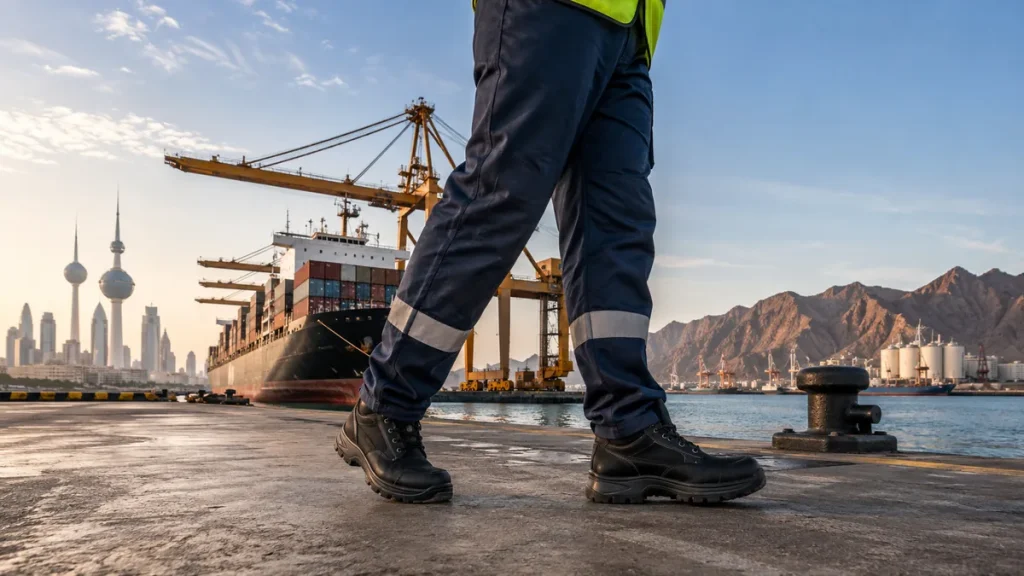
While Saudi Arabia and the UAE tend to dominate Gulf PPE conversations, Kuwait and Oman represent substantial and growing demand for quality safety footwear. Both countries have large industrial workforces, active infrastructure development programmes, and regulations requiring compliant PPE across construction, oil and gas, manufacturing, and logistics.
Kuwait: Industrial Profile and Safety Footwear Demand
Kuwait’s economy is heavily centred on oil and gas, employing a significant proportion of its expatriate workforce. Industrial cities (Shuaiba, Subhan) host chemical plants, manufacturing units, and logistics operations.
The primary demand driver. S3 SRC footwear with HRO and ESD properties is standard specification across major operator sites.
Active residential and commercial construction generates consistent demand for S3 rated safety footwear with penetration-resistant midsoles.
Stevedoring and logistics at major Gulf ports require S3 with SRC grip and metatarsal protection for cargo handling roles.
Industrial zone facilities require standardised IS:15298/GSO-compliant safety footwear across production floor roles.
Oman: A Growing Industrial Market
Oman’s industrial landscape has diversified as part of Vision 2040. The Duqm Special Economic Zone and Sohar Port and Freezone are among the fastest-growing industrial complexes in the region, attracting petrochemicals, manufacturing, and logistics investment.
Petroleum Development Oman and its supply chain represent the largest safety footwear buyer segment in the country.
Active mining operations require S3 with penetration-resistant midsoles, high ankle support, and SRC slip resistance.
New industrial investment at Duqm is creating fresh demand for certified PPE from a growing on-site workforce.
National development programme spending continues to generate consistent construction PPE demand across the country.
Applicable Standards: GSO 1906
Both Kuwait and Oman are member states of the Gulf Standards Organization (GSO). GSO 1906 — harmonised with EN ISO 20345:2011 — is the applicable standard for safety footwear in both countries. For construction and oil and gas facilities, S3 is the baseline minimum specification.
| Classification | What It Means |
|---|---|
| S1 | Steel toe + anti-static + energy absorption at heel |
| S2 | S1 + water-resistant upper |
| S3 | S2 + penetration-resistant midsole |
| HRO | Heat-resistant outsole (300°C/60s) |
| ESD | Electrostatic discharge protection |
| SRC | Slip resistance on both ceramic tile (SRA) and steel floor (SRB) |
How Indian Manufacturers Compete
- Price advantage — Indian manufacturing costs allow pricing 20–35% below equivalent European brands without compromising quality.
- Standards alignment — IS:15298 aligns with EN ISO 20345 which aligns with GSO 1906. The gap is documentation, not product re-engineering.
- Supply chain proximity — 5–10 day shipping from Indian west coast ports versus 3–5 weeks from Europe.
- Workforce familiarity — a large portion of Kuwait and Oman’s industrial workforce originates from India, bringing brand recognition to Indian manufacturers.
What Distributors Should Ask Indian Suppliers
- IS:15298 BIS certification number — verify on the BIS portal, not just the label
- EN ISO 20345 test reports from SGS, Bureau Veritas, Intertek, or TÜV — these accelerate GSO compliance applications
- ISO 9001 factory certificate — reduces friction on any required factory audit
- Consistent quality across production runs — Gulf projects require re-orders months after initial supply
- COC documentation support — product samples, datasheets, factory inspection participation
Indcare: Actively Building Gulf Distribution
Mittal Safety Works manufactures Indcare safety shoes at our Delhi facility under ISO 9001:2015 and ISO 14001:2015 quality management systems. Our BIS certification to IS:15298 provides the standards documentation, and we can support Gulf distributors through EN ISO 20345 / GSO testing processes.
We welcome inquiries from Kuwait and Oman-based PPE distributors, industrial supply companies, and construction material traders with access to the safety PPE category.
Conclusion
Kuwait and Oman are substantial industrial economies with genuine demand for quality, certified safety footwear. The GSO 1906 compliance framework is well-defined, and the documentation requirements are manageable for a well-organised Indian manufacturer. The combination of standards alignment, cost competitiveness, and geographic proximity makes this a compelling proposition for the right Gulf distribution partner.