
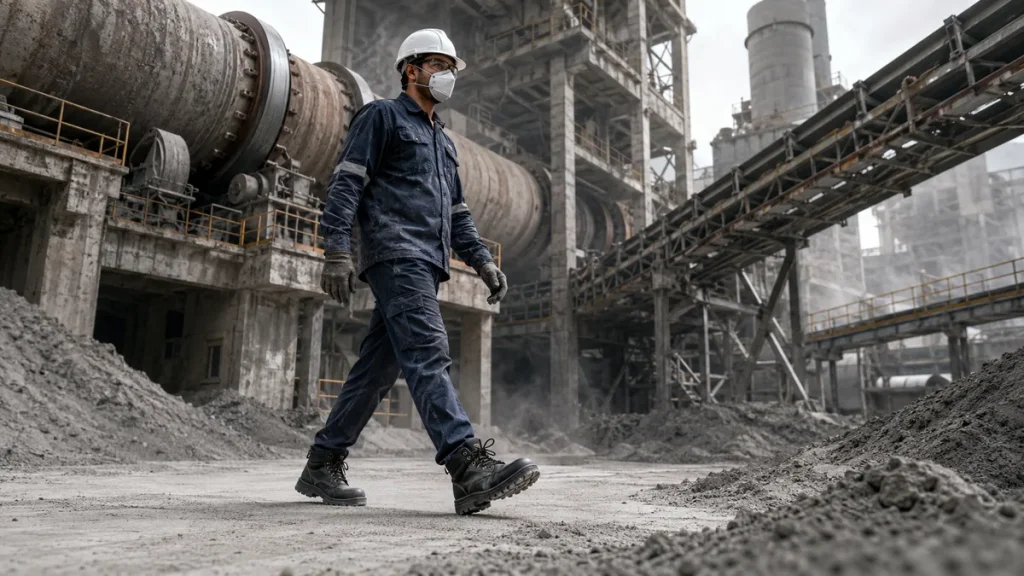
India is the world’s second-largest cement producer, with over 500 plants operating across Rajasthan, Madhya Pradesh, Andhra Pradesh, Tamil Nadu, Chhattisgarh, and Maharashtra. The cement sector employs hundreds of thousands of workers in environments that combine multiple serious hazards: extreme heat, alkaline chemical exposure, heavy mechanical equipment, dust-covered floors, and the constant risk of falling objects.
Yet safety footwear procurement in many cement plants still defaults to whatever the local market supplies cheapest. This guide explains why that approach is a false economy — and what the correct specification looks like.
Hazards and Footwear Specification by Work Zone
Each zone in a cement plant carries a distinct hazard profile. Specifying one shoe for all workers is both incorrect and costly.
- Falling rocks and limestone chunks — steel toe cap (200J) mandatory
- Coarse, irregular surfaces with constant trip hazards
- Heavy equipment movement — crush risk from wheels and tracks
- Floor temperatures 200–300°C near kiln outlets and clinker conveyors
- Significant radiant heat exposure throughout shift
- Clinker dust is highly alkaline (pH 11–12) — destroys standard PU outsoles
- Fine cement dust on smooth concrete — one of the most treacherous slip conditions in any industry
- Conveyor spillage creates additional unpredictable slip zones
- Long standing hours on hard vibrating surfaces — musculoskeletal risk
- Heavy cement bags (50kg) — drop-foot risk on loading docks
- 8–12 hour shifts on hard concrete floors
- Conveyor belt entanglement and pinch points
- General mechanical risk across all zones
- Electrical risk near switchgear and motors
- Access to high-temperature zones
The Chemistry Problem: Alkaline Degradation
This is the most underappreciated hazard in cement industry footwear. Fresh cement is highly alkaline — pH 12 to 13. Wet cement, clinker dust, and washdown water create a persistently alkaline floor environment.
Standard PU (polyurethane) outsoles are vulnerable to hydrolysis — the alkaline environment breaks down PU polymer chains over time, causing the outsole to become brittle, crack, and delaminate. A shoe that falls apart in six weeks is not a cost saving — it is a safety failure.
Outsole Comparison for Cement Plant Environments
| Property | PU | Rubber | PVC |
|---|---|---|---|
| Heat resistance | Poor above 80°C | Good (compound dependent) | Poor |
| Alkaline resistance | Poor | Good | Moderate |
| Slip resistance | Good | Good | Moderate |
| Weight | Light | Heavier | Light |
| Best for | Office/admin only | Kiln zones, clinker handling | Light maintenance |
For most production workers in a cement plant, rubber outsole construction is the correct specification. The weight penalty is modest against the durability and alkaline resistance advantages.
What Cement Plant Procurement Teams Must Verify
- Verify the BIS certification number — not just the ISI mark logo. A valid BIS certificate has a registration number verifiable on the BIS portal.
- Request the HRO/HI test report for kiln zone workers — verbal claims are not sufficient documentation for a safety audit.
- Check the slip resistance classification — S1 is insufficient for most production areas. S2 or S3 minimum.
- Review the outsole specification for alkaline resistance — ask for documented test data, not just a product description.
Worker Comfort: The Productivity Dimension
Cement plant workers stand for 8–12 hours on hard vibrating floors. Foot fatigue reduces concentration and increases accident risk. Evaluate these features when selecting footwear:
- Energy-absorbing heels — reduces impact shock on concrete floors throughout the shift
- Cushioned insoles — shock absorption for long standing periods; replace every 6–9 months
- Moisture-wicking lining — reduces blister risk in hot environments; critical in kiln zone roles
- Correct sizing — feet swell in high-heat areas; size up slightly for kiln and clinker zone workers
Indcare for Cement and Construction Materials Manufacturing
Mittal Safety Works’ Indcare range is designed for Indian industrial conditions — addressing real-world exposure like alkaline environments, heat, and long shifts on hard surfaces. Our products carry BIS certification to IS:15298 and are produced under ISO 9001:2015 and ISO 14001:2015 quality management systems.
We supply through a dealer and distributor network and can fulfil bulk procurement requirements for cement plant contractors and plant operators across India.
Conclusion
The cement industry demands more from safety footwear than most procurement teams specify. The combination of alkaline exposure, heat, slip hazard, and heavy loads means a generic safety shoe — even a certified one — may not be right for every work zone.
Build your specification from the hazard profile of each zone. When an outsole starts to crack before its expected life, treat that as a data point for the next procurement cycle.