
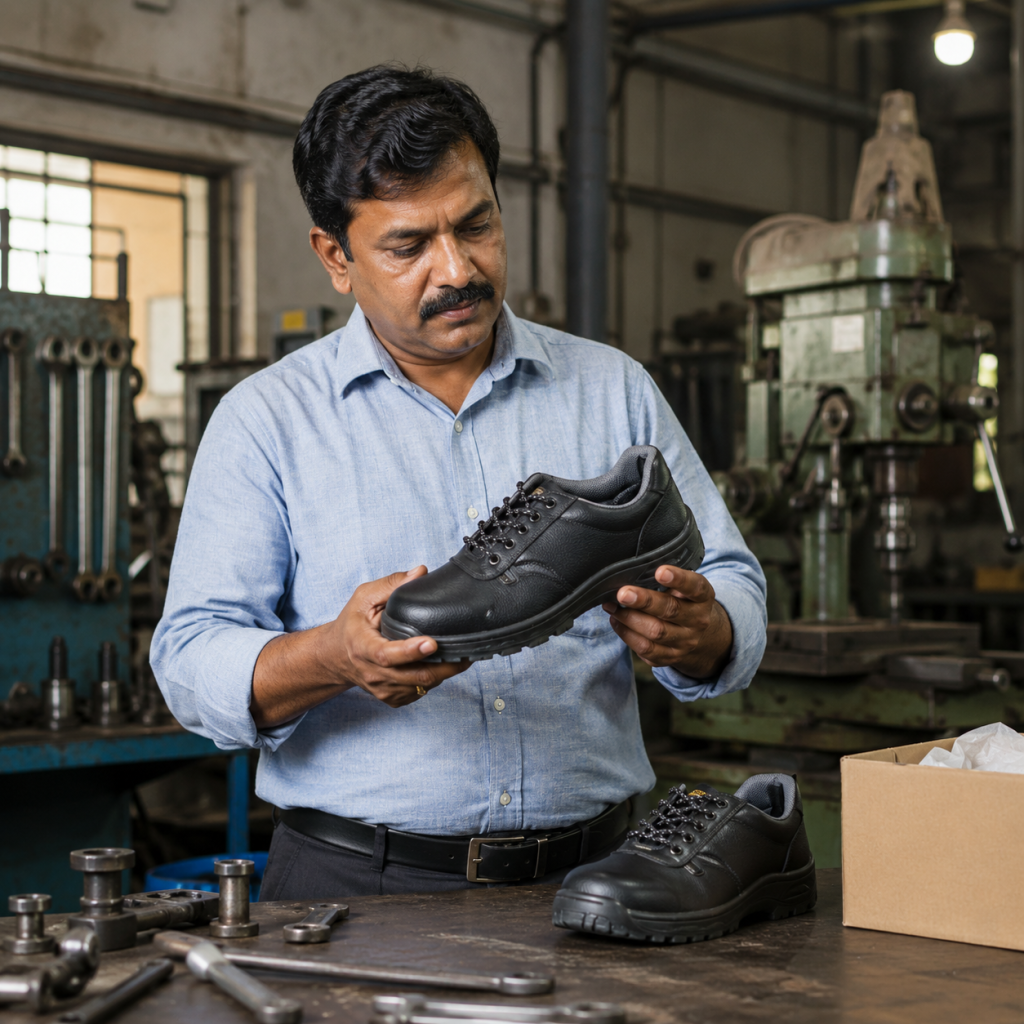
Most safety footwear guidance is written for large companies with dedicated safety departments. But most Indian industrial workers are employed by SMEs — the fabrication workshop, the textile unit, the auto components manufacturer. This guide is written specifically for SME owners and managers.
The Legal Picture for SMEs
The Factories Act, 1948 applies to any premises with 10 or more workers using power (or 20 without power). The requirement to provide appropriate PPE including safety footwear is not size-dependent. The Occupational Safety, Health and Working Conditions Code, 2020 has strengthened these requirements. Non-compliance creates compensation liability under the Employees’ Compensation Act, 2010 that can far exceed the cost of providing proper footwear.
A Simple 5-Step Procurement Process
- Identify your hazards — falling objects? Wet/chemical floors? Sharp debris? Oily surfaces?
- Choose your model — Hawk PU for most dry environments; Polo PVC for wet/chemical
- Know your sizes — measure workers’ feet; size on the larger side
- Calculate your order — workers per size + 10–15% for new joins and replacements
- Request a quotation — we respond within one business day
Common SME Mistakes to Avoid
- Buying on price alone — cheap uncertified shoes cost more per year and cause injuries
- Not replacing worn footwear — flat soles provide zero protection
- Letting workers buy their own — results in no documentation and inconsistent protection
Understanding Your Legal Obligations
The Factories Act 1948 applies to any premises employing 10 or more workers with power, or 20 or more without power. Section 35 of the Act requires employers to provide protective equipment where workers are exposed to risk of bodily injury. This applies regardless of company size — there is no SME exemption.
The Occupational Safety, Health and Working Conditions Code 2020 (OSHWC Code) has consolidated and strengthened these obligations. Under Section 13, employers must provide PPE free of cost to workers in hazardous processes. Section 14 imposes a duty to maintain PPE and ensure it is in good condition. Under the Employees’ Compensation Act 2010, an employer whose worker is injured in the absence of adequate PPE faces uncapped compensation liability — which in practice regularly exceeds ₹5–10 lakhs for significant foot injuries.
How to Build Your SME Footwear Specification
You do not need a dedicated safety department to build a functional footwear specification. A simple two-page document covers everything required:
- Hazard list — list the actual hazards in your workplace: falling objects, wet floors, chemical splash, sharp debris, oil contamination, outdoor work
- Model selection — match one or two approved models to your hazard list. Do not mix uncertified and certified footwear in the same environment.
- Size range — record the size distribution of your workforce. Hold a small buffer of adjacent sizes.
- Issue log — maintain a spreadsheet: worker name, date issued, model, size, signature. This is your compliance record under the Factories Act inspection regime.
- Replacement trigger — define what “worn out” means: sole depth below 3mm, toe cap exposed, delamination at welt. Do not rely on calendar intervals alone.
Annual Supply Planning for SMEs
For a 50-person workforce with 12–18 month footwear life, you are looking at roughly 33–50 pairs per year in replacement, plus 10–15% buffer for new staff and damaged footwear. A single annual order of 60–65 pairs covers this without mid-year stock shortages. For smaller SMEs, a half-yearly order cadence keeps stock fresh without requiring large upfront expenditure.
| Workforce Size | Annual Replacement (est.) | Recommended Order Frequency |
|---|---|---|
| 10–25 workers | 10–20 pairs | Annual single order |
| 25–75 workers | 20–60 pairs | Annual or bi-annual |
| 75–150 workers | 60–120 pairs | Bi-annual with size review |
| 150+ workers | 120+ pairs | Quarterly delivery schedule |
Related Reading
- IS:15298 Explained — What Certification Means
- How to Identify Fake Safety Shoes in India
- Safety Shoe Replacement Schedule
- PU vs PVC — Which Does Your Workplace Need?
Choosing the Right Model for Your SME Environment
Most SME owners do not need to navigate the full catalogue to find the right safety shoe. A simple decision tree works for most Indian SME environments:
| Your Primary Environment | Recommended Model |
|---|---|
| Dry manufacturing, engineering, workshop | Hawk PU — steel toe, oil resistant, BIS IS:15298 |
| Wet floors, chemical exposure | Polo PVC or Ranger PVC — fully waterproof |
| Outdoor, construction, monsoon | Jungle Boot PVC — steel toe gumboot |
| Long-standing shifts (8+ hours) | Jumbo Z+ PU — enhanced cushioning |
| Abrasive floors, metal shavings | Rock DD PU — double density sole |
If you are unsure which model is right for your specific environment, contact our team — we provide specification support at no cost. We would rather help you specify correctly than have you receive footwear that does not suit your workplace.
Related Reading
- PU vs PVC Safety Shoes — Full Comparison
- How to Identify Fake Safety Shoes
- Safety Shoe Replacement Schedule