
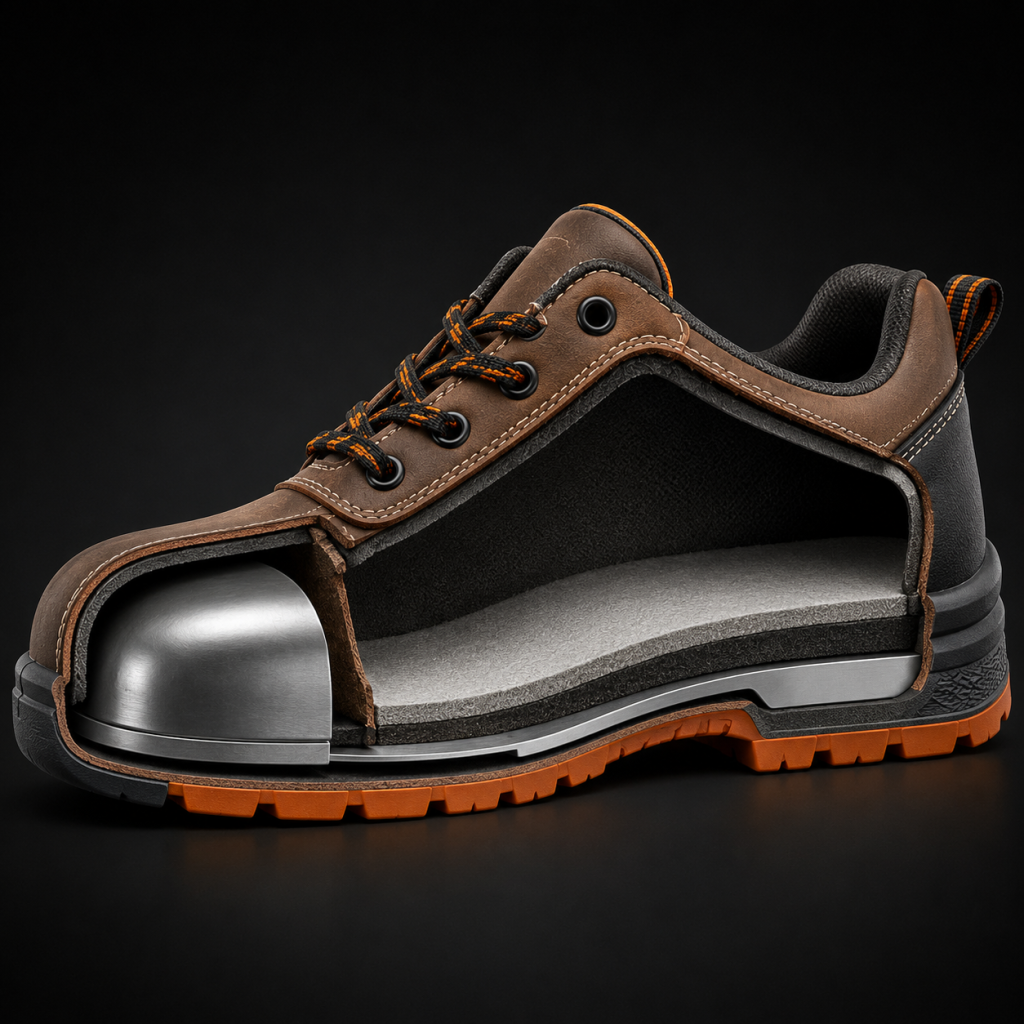
Every year, thousands of workplace injuries in India involve the feet and lower legs — crushed toes from falling objects, puncture wounds from sharp debris, slips and falls on wet industrial floors, and chemical burns from spills that reached the foot. Most of these injuries are entirely preventable with properly specified safety footwear.
Yet footwear is often the last item on a safety manager's priority list, and the first item where cost is allowed to compromise specification. This is a false economy — the cost of one workplace foot injury, including medical treatment, lost working days, and compliance consequences, will far exceed the cost of equipping an entire team with quality safety shoes.
What Industrial Safety Footwear Actually Protects Against
Impact and Crush Injuries
Steel or composite toe caps rated to IS:15298 or EN ISO 20345 are designed to withstand a defined impact energy and compression load — typically 200J impact and 15kN compression. In practical terms, this means a reasonable fall from a working height or the weight of industrial equipment rolling over the foot will not result in crushed toes.
The Hawk PU, Rock PU, and Polo PVC from the Indcare range all feature steel toe protection meeting these requirements.
Penetration from Below
Construction sites, fabrication yards, and demolition environments have nails, rebar ends, and sharp debris on the ground. A midsole penetration plate — typically steel, rated to a defined puncture resistance — prevents sharp objects from coming through the sole and into the foot. Indcare models with penetration protection are identified in their product specifications.
Slip and Fall Prevention
Slip-and-fall accidents on wet industrial floors are the most common cause of workplace foot and lower body injuries. The outsole compound and tread pattern of safety footwear must be appropriate for the specific floor surface and contaminant. An oil-resistant PU sole on concrete performs very differently from a PVC sole on a wet tile floor.
Indcare soles are specified for the typical Indian industrial floor. For heavily oiled floors, our Rock PU and Hawk PU are appropriate. For wet and chemically exposed floors, PVC construction — such as the Hector PVC or Jungle Boot PVC — provides better chemical resistance.
Chemical Exposure
In chemical processing, pharmaceuticals, and cleaning operations, the sole and upper must resist the specific chemicals present. Not all safety shoes are chemically resistant. PVC construction provides good resistance to common industrial acids and alkalis. For specific chemical environments, consult with your safety officer to verify the shoe specification against the chemicals involved.
Specifying the Right Footwear for Your Industry
| Industry | Primary Hazard | Recommended Indcare Range |
|---|---|---|
| Manufacturing / Engineering | Impact, abrasion, oil | Hawk PU, Rock PU |
| Construction | Penetration, impact, uneven surfaces | Rock PU, Jumbo PU |
| Chemical / Pharma | Chemical splash, wet floors | Hector PVC, Polo PVC |
| Food Processing | Wet floors, hygiene | Polo PVC, Jungle Boot PVC |
| Logistics / Warehouse | Impact, long wear hours | Jumbo Z+ PU, Hawk PU |
| Agriculture / Outdoor | Water, uneven terrain | Jungle Boot PVC |
Compliance and Documentation
For government, PSU, and large corporate procurement, safety footwear must be specified against and compliant with the applicable Indian Standard — primarily IS:15298. Mittal Safety Works provides complete compliance documentation, including BIS certification, ISO quality certificates, and product test reports, for vendor qualification and audit purposes.
View our certifications page or contact us to request documentation for your procurement process.
Bulk Procurement with Mittal Safety Works
We supply Indcare safety footwear directly to industries, safety contractors, and dealers across India. For bulk orders, we offer size-wise quantity pricing, Pan-India delivery, and dedicated support from our sales team. Request a bulk quote today.
How to Read Your Workplace Hazard Profile
Most workplace foot injuries fall into six categories: falling objects, compression, penetration, slip and fall, chemical exposure, and thermal exposure. Understanding which of these are present in your environment — and at what severity — is the foundation of correct footwear specification. IS:15298 certification confirms protection against the first three and provides baseline protection for the fourth. The fifth and sixth require additional specification.
| Hazard | What IS:15298 Provides | Additional Specification If Needed |
|---|---|---|
| Falling objects | 200 J impact — covers most industrial dropping scenarios | Metatarsal guard for very heavy objects (>20kg from significant height) |
| Compression (rolling objects) | 15 kN — approximately 1,500kg static load equivalent | Reinforced midsole for tracked vehicle environments |
| Sharp penetration from below | Penetration-resistant midsole (IS:15298 option) | Specify explicitly — not all IS:15298 models include this |
| Slip and fall | SRB slip resistance on wet ceramic | SRC for oily metal floors; specific anti-static for explosive atmosphere |
| Chemical exposure | Oil and fuel resistance only | Full PVC for acid, alkali; specialist chemical resistance for specific compounds |
| Thermal exposure | Not covered in base standard | IS:15298 Part 3 heat resistance; specialist specification for molten metal proximity |
The Specification Decision Process
Correct footwear specification follows a clear logic. Start with the hazard profile, not with the product catalogue:
- List every zone in your facility and its primary foot hazard
- Confirm IS:15298 as the baseline for all zones with any overhead hazard
- Identify zones requiring additional properties beyond IS:15298 base
- Select the minimum specification that covers all identified hazards
- Confirm with your supplier that the selected model has been tested for all your requirements
Practical Specification Examples by Industry
- Construction — IS:15298 + penetration resistance for rebar environments; PVC gumboot for monsoon outdoor work
- Chemical processing — IS:15298 + full PVC construction + chemical resistance confirmation for specific compounds
- Food processing — IS:15298 + full PVC smooth upper for hygiene zones; IS:15298 + anti-static for electronics packaging lines
- Steel and metal — IS:15298 + double-density sole for abrasion; Part 3 heat resistance for furnace-adjacent zones
- Logistics — IS:15298 SRB for dock areas; cushioned PU for long-standing pick-and-pack
Related Reading
- IS:15298 Explained — Full Standard Breakdown
- PU vs PVC — Hazard-Based Selection Guide
- Why Safety Shoes Are Essential in Every Industrial Workplace
- Top 10 Factors in Safety Footwear Selection