
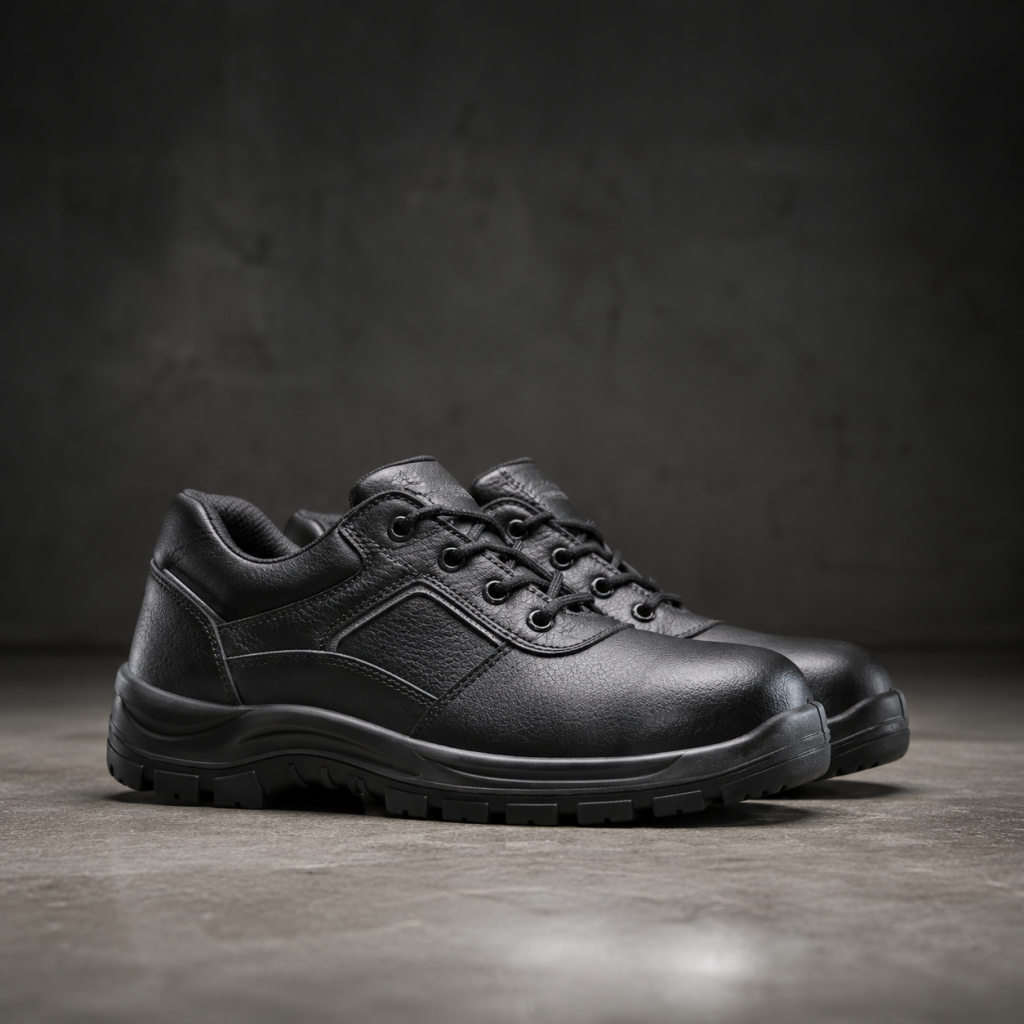
Buying safety shoes is not the same as buying regular footwear. A wrong choice of running shoe leads to mild discomfort. A wrong choice of safety shoe in a hazardous industrial environment can result in a serious injury. The decision deserves more attention than most purchasing processes give it.
This guide covers the nine factors that matter most when specifying or purchasing safety footwear — whether you are buying for yourself or for an entire industrial workforce.
1. Start with the Hazard Assessment, Not the Catalogue
The single most important step in buying safety shoes is understanding the actual hazards in your specific work environment. Impact risk from overhead loads? Penetration risk from debris on the floor? Chemical splash? Electrical hazard? Wet and slippery surfaces? The shoe specification follows from the hazard — not from what is available at a particular price point.
If you are a safety officer purchasing for a workforce, conduct or review a formal risk assessment before approaching suppliers. If you are purchasing for yourself, speak to your safety officer about the formal specification for your role. Mittal Safety Works can assist procurement teams with hazard-to-specification mapping for common Indian industrial environments.
2. Toe Protection: Steel, Composite, or Alloy?
All three provide impact and compression protection to IS or EN ISO specification. The differences are:
- Steel toe — the industry standard, most economical, meets full specification. Suitable for the vast majority of industrial environments. All Indcare PU and PVC safety shoes use steel toe caps.
- Composite toe — non-metallic (fibreglass or carbon fibre), lighter, passes metal detectors, does not conduct heat or cold. Used where metal detection is required (airports, certain manufacturing) or where workers are exposed to extreme temperatures.
- Aluminium/alloy toe — lighter than steel, still metallic. A middle ground option less commonly specified in the Indian market.
For most Indian industrial workers — manufacturing, construction, logistics, chemical — a steel toe cap to IS:15298 is the appropriate and cost-effective specification.
3. Slip Resistance for Your Specific Floor
Slip resistance ratings (SRA, SRB, SRC under European standards; similar requirements under IS:15298) are measured on specific floor surfaces with specific contaminants. SRA is tested on ceramic tile with sodium lauryl sulphate (soap solution). SRB is on steel with glycerol (oil). SRC meets both.
If your floor is oiled steel, you need SRB or SRC performance. If it is wet tile, SRA performance is the priority. Ask your supplier to confirm the slip resistance rating and the test surface it was achieved on — not just that the shoe is “slip resistant.”
Indcare PU soles are formulated for oil-contaminated concrete and tile — the most common Indian industrial floor surface. For chemically contaminated or constantly wet floors, our PVC range performs better.
4. Penetration Protection
If your environment has nails, rebar ends, glass, or other sharp debris on the floor (construction sites, demolition, fabrication yards), a midsole penetration plate is essential. IS:15298 specifies the minimum penetration resistance required. Not all safety shoes include this — confirm with the supplier before purchase.
5. Fit and Sizing
An ill-fitting safety shoe is a hazard in itself. Too tight and the worker removes the shoe at the first opportunity; too loose and the foot slides inside the shoe, reducing the protective effectiveness of the toe cap and increasing fatigue and fall risk.
Indcare footwear is available in standard Indian sizes (Size 6 to Size 11) with appropriate forefoot width for the Indian foot. When purchasing for a workforce, do not assume size from the worker's regular shoe — measure properly, especially if sourcing for the first time.
6. Upper Material: PU, PVC, or Leather?
- PU construction — the most versatile. Good combination of comfort, breathability, and durability for most dry industrial environments. Our PU range includes the Hawk PU, Rock PU, Jumbo Z+ PU, and others.
- PVC construction — fully waterproof, chemical-resistant, easy to clean. Preferred for wet, hygiene-sensitive, or chemically contaminated environments. Our PVC range includes the Polo PVC, Hector PVC, and Jungle Boot PVC.
- Leather upper — traditional, durable, good breathability. Requires conditioning to maintain water resistance. Used in certain premium specifications but less common in Indian bulk industrial supply due to maintenance requirements.
7. Ankle Support
Standard safety shoes (ankle height) are appropriate for flat, even industrial floors. For uneven terrain, outdoor sites, and environments where ankle roll is a risk, a mid- or high-cut boot provides better lateral support. The Jungle Boot PVC is a full ankle boot appropriate for outdoor and wet environments.
8. Certification and Compliance Documentation
For formal procurement — government, PSU, large corporate — the safety shoes must meet the applicable Indian Standard (IS:15298 for general industrial safety footwear) and the supplier must be able to provide documentary evidence. This includes test reports, BIS licence copies, and ISO quality certification.
Mittal Safety Works provides complete certification documentation with every bulk order. View our certifications page for details of our current certifications, or contact us to request specific documentation for your procurement process.
9. Total Cost of Ownership, Not Unit Price
The price per pair is the least useful metric for safety footwear procurement. A shoe priced at Rs. 800 that lasts four months costs Rs. 2,400 per year. A shoe priced at Rs. 1,400 that lasts fourteen months costs Rs. 1,200 per year — and causes fewer foot injuries in the process.
When evaluating Indcare footwear, we encourage a total cost calculation based on expected lifespan in your specific environment, the cost of foot injuries in your workforce, and the compliance cost of footwear that does not meet standard. We are happy to support this calculation. Request a quote and speak to our team.
Browse our range — BIS IS:15298 compliant, bulk supply available across India, Gulf and USA.