
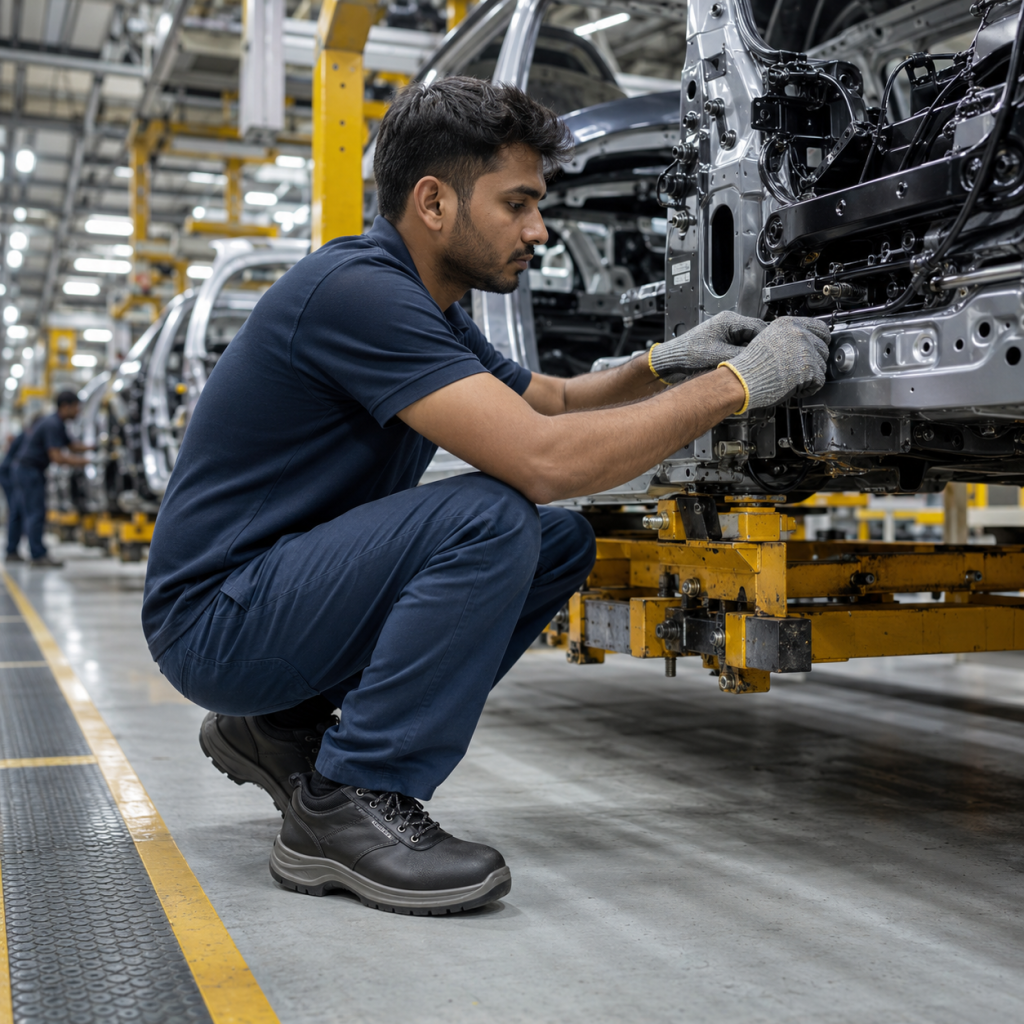
India is the world’s third-largest automobile market. The country’s auto manufacturing ecosystem — from OEM assembly plants to tier-1 and tier-2 component suppliers — employs hundreds of thousands of workers in environments where foot hazard specifications vary significantly by zone.
Zone-by-Zone Specification
| Zone | Primary Hazard | Recommended |
|---|---|---|
| Body shop | Impact, metal edges, weld spatter | Rock PU / Hawk PU |
| Paint shop | Chemical, anti-static | Caliber PVC |
| Assembly line | Rolling vehicle crush, long standing | Jumbo Z+ PU / Hawk PU |
| Press shop | Severe impact, compression | Rock DD PU |
| Machine shop | Metal swarf, cutting fluids | Rock PU |
| Logistics/stores | Moderate impact, long standing | Hawk PU / LS-01 PU |
OEM Vendor Audit Compliance
Large Indian OEMs increasingly require tier-1 and tier-2 suppliers to demonstrate IS:15298 compliance in footwear as part of vendor audits. Mittal Safety Works provides the full documentation package required for OEM vendor qualification — BIS licence, ISO 9001, test reports. View our certifications.
The Indian Automotive Manufacturing Landscape
India is the world’s third-largest automobile market and a significant global manufacturing hub. The automotive ecosystem — from large OEM assembly plants in Pune, Chennai, Gurugram, Sanand and Aurangabad, to tier-1 and tier-2 component suppliers spread across industrial clusters nationwide — employs hundreds of thousands of production workers. The variety of processes within a single automotive plant creates a highly varied footwear specification challenge.
OEM Vendor Audit Compliance
Large Indian OEMs and their multinational parents increasingly include safety footwear compliance in vendor quality audits. Under IATF 16949 (the automotive sector quality management standard), supplier facilities are required to demonstrate systematic PPE management. Safety officers at tier-1 and tier-2 suppliers who cannot produce IS:15298 documentation, issue registers, and replacement records during audit are creating quality non-conformances with direct commercial consequences — including supplier delisting risk.
ESD Footwear for Electronics Assembly
Automotive electronics — ECUs, sensors, actuators, wiring harnesses — is one of the fastest-growing segments of the Indian automotive supply chain. Electronics assembly areas require anti-static or ESD (electrostatic discharge) footwear to prevent static charge buildup that can damage components. Standard IS:15298 safety shoes are not ESD rated. If your facility includes electronics assembly or test areas, confirm the ESD requirement with your process engineer before specifying footwear.
Ergonomics on Assembly Lines
Assembly line workers in automotive plants typically work standing shifts of 8–10 hours on concrete or epoxy floors. Fatigue is a significant contributor to slip and trip incidents in the second half of the shift. Footwear specification for assembly line workers should prioritise cushioning and energy return — models like the Jumbo Z+ PU, which provides enhanced midsole cushioning, directly reduce fatigue-related incident risk in long-standing applications.
Maintenance and Tool Room Specification
Maintenance engineers in automotive plants move across all zones — from production floor to electrical panels, from outdoor vehicle testing areas to precision machine shops. Their footwear specification must meet the highest-risk zone they regularly access. Double-density PU models provide extended sole life in the mixed-surface environments that maintenance workers traverse daily.
Related Reading
- PU vs PVC Safety Shoes — Which Does Your Industry Need?
- Anti-Slip Safety Shoes — Why Slip Resistance Matters
- Steel Toe vs Composite Toe — The Complete Comparison
- Safety Footwear Compliance for Large Industrial Procurement
- Safety Shoe Replacement Schedule
Supplier Tier Compliance — What Tier-1 and Tier-2 Auto Suppliers Need
The Indian automotive supply chain operates under a layered audit regime. OEM assembly plants conduct periodic supplier assessments, and safety compliance — including PPE documentation — is a standard audit element. For tier-1 suppliers, this typically means annual vendor audits by OEM quality teams. For tier-2 suppliers feeding tier-1 operations, the same standards cascade through sub-vendor agreements.
In practice, this means: if you supply components to Maruti Suzuki, Toyota, Hyundai, Tata Motors, Mahindra or any other major OEM, your facility will be audited for IS:15298 compliant footwear documentation. The audit checklist typically requires the same elements as any Factories Act inspection: IS:15298 BIS licence, issue register, and replacement records.
Specification by Vehicle Segment
Different segments of the automotive industry have different dominant hazards:
- Commercial vehicle manufacturing — heavy components, chassis handling, high-impact risk. Rock DD PU or similar double-density specification.
- Passenger car assembly — moderate component weight, long-standing assembly lines, precision work. Jumbo Z+ PU or Hawk PU for comfort on shift.
- Two-wheeler manufacturing — smaller components, faster line speed, ergonomics priority. Hawk PU or LS-01 PU.
- Auto components — forging and casting — heavy components, hot surfaces, abrasive floors. Double-density PU with heat-resistant sole consideration.
- Auto components — plastic and rubber — chemical exposure (release agents, adhesives), slip on smooth floors. PVC safety shoes.
Related Reading
- PU vs PVC Safety Shoes — Full Comparison
- IS:15298 Explained — Certification Requirements
- Steel Toe vs Composite Toe — Which Is Right?
- Safety Footwear for Large Industrial Procurement