
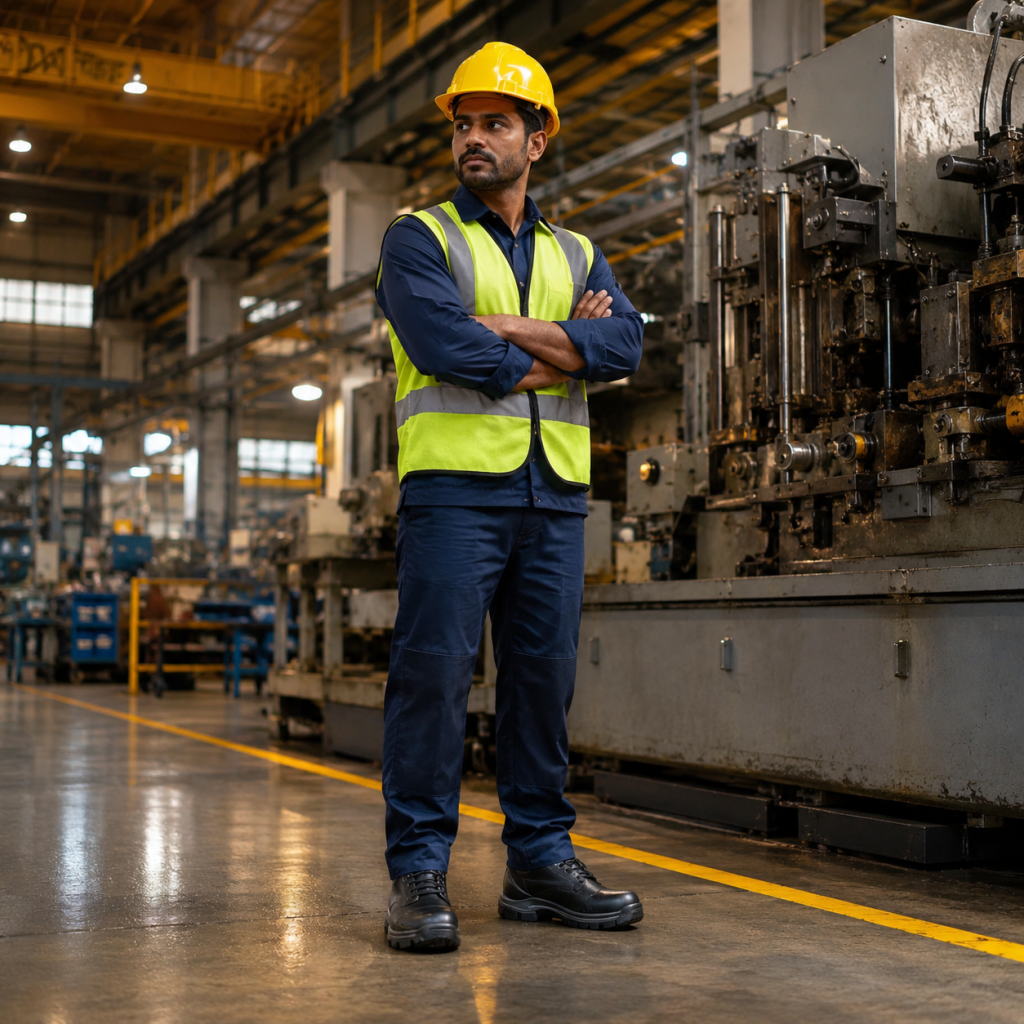
India’s manufacturing sector employs over 57 million workers across industries ranging from automobile assembly and chemical processing to textile mills, steel plants, and food packaging facilities. Every single working day, thousands of these workers face foot hazards that can result in injuries severe enough to keep them off the floor for weeks — or permanently.
Yet safety footwear remains one of the most underspecified items in the Indian industrial procurement process. Companies spend considerable amounts on machinery, compliance documentation, and safety training — and then purchase whatever safety shoes are cheapest in the market, often without verifying whether those shoes meet any standard at all.
At Mittal Safety Works, we have been manufacturing Indcare safety footwear for Indian industrial conditions since our founding. This article gives manufacturing workers and safety managers the complete picture on what safety shoes are, why they matter, and how to choose correctly.
What Hazards Do Manufacturing Workers Face?
Impact and Crush Injuries
Falling components, rolling carts, heavy tooling, and material handling equipment can land on a worker’s foot with enormous force. Without a steel toe cap rated to IS:15298, a falling object of even moderate weight at working height can crush the toes completely.
Sharp Objects on the Floor
Metal shavings, off-cuts, dropped fasteners, and broken tooling are a permanent feature of most manufacturing floors. Without a penetration-resistant midsole, these can penetrate straight through the sole and into the foot.
Slip and Fall
Oil, coolant fluids, water from cleaning operations, and fine metal dust all create treacherous floor conditions. Slip-and-fall accidents are statistically the most common cause of non-fatal industrial injuries in India.
Chemical Exposure
Cutting oils, hydraulic fluids, cleaning solvents, and surface treatments cause skin damage and systemic health risks through prolonged contact with inadequate footwear.
The BIS IS:15298 Standard
In India, the relevant standard for industrial safety footwear is IS:15298, issued by the Bureau of Indian Standards. It defines minimum requirements including:
- Toe cap impact resistance: 200 joules
- Compression resistance: 15 kilonewtons
- Slip resistance: SRA, SRB, or SRC rated
- Penetration resistance: midsole plate tested against sharp objects
All Indcare safety footwear manufactured by Mittal Safety Works meets BIS IS:15298 specifications with full compliance documentation.
PU vs PVC: Which for Manufacturing?
PU (Polyurethane) safety shoes are the standard choice for most dry manufacturing environments — lighter, better cushioned, oil resistant, and comfortable for extended shifts. Key models include the Hawk PU, Rock PU, and Jumbo Z+ PU.
PVC safety shoes are appropriate where water resistance and chemical protection are required — food processing lines, chemical manufacturing, environments with regular floor washdown. The Polo PVC and Hector PVC serve these environments.
The Business Case for Quality Safety Footwear
A workforce of 100 workers wearing cheap shoes at ₹700 replaced every four months costs ₹2,10,000 annually. Quality Indcare shoes at ₹1,400 lasting 14 months costs ₹1,20,000 — a saving of ₹90,000 before accounting for injury-related costs. One moderate foot injury easily costs several lakhs in medical, legal, and productivity losses.
What Mittal Safety Works Offers
- Complete PU and PVC safety shoe range — 30+ variants
- Sizes 6 to 11 with Indian foot lasts
- BIS IS:15298 and ISO 9001:2015 compliance documentation
- Bulk pricing with size-wise quotations
- Pan-India delivery and dealer network support
Request a Bulk Quote Browse the Full Range →
The Manufacturing Foot Hazard Environment
Indian manufacturing covers an enormous range of environments — from pharmaceutical cleanrooms to steel foundries, from textile mills to automotive assembly plants. The common thread is that manufacturing workers are on their feet for extended periods in environments where foot hazards are consistently present. The specific hazard combination varies significantly by sector, which is why zone-specific specification is more effective than a single-model approach.
Common Manufacturing Environments and Their Footwear Requirements
| Manufacturing Sector | Key Foot Hazards | Recommended Specification |
|---|---|---|
| Textile and garment | Long standing, slip on smooth tile, needle penetration | IS:15298 with penetration resistance; lightweight PU |
| Auto components — forging | Heavy falling components, abrasive floor, hot surfaces | Double-density PU, IS:15298; consider heat-resistant sole |
| Plastics and rubber | Chemical release agents, slip, moderate impact | PVC safety shoe or chemical-resistant PU |
| Food and beverages | Wet floors, hygiene requirements, chemical washdown | Full PVC construction; food-safe smooth upper |
| Pharmaceuticals | GMP compliance, potential anti-static requirement | PVC smooth construction; confirm ESD if required |
| Engineering and fabrication | Metal shavings, falling components, oil on floor | IS:15298 SRC; double-density for abrasive environments |
| Paper and printing | Slip on ink-contaminated floors, moderate impact | IS:15298 SRB; oil-resistant sole |
The 10+ Hour Shift Challenge
Indian manufacturing routinely operates on 10-12 hour shifts. Worker fatigue is a significant contributor to slip and fall incidents in the second half of shift — specifically between hours 8 and 12, when cumulative standing fatigue is highest and alertness is reduced. Footwear specification for extended-shift workers should prioritise cushioning and energy return alongside protection.
The Jumbo Z+ PU was specifically developed for this application. Its enhanced midsole cushioning provides measurably better energy return than standard single-density models, reducing cumulative fatigue over a 10-12 hour shift. For manufacturing operations running double shifts, this specification makes a documented difference in end-of-shift comfort and alertness.
Related Reading
- PU vs PVC — Full Specification Guide
- Anti-Slip Safety Shoes
- IS:15298 Explained
- Safety Shoe Replacement Schedule for Manufacturing
- Indcare Safety Shoes — Built for Indian Conditions