
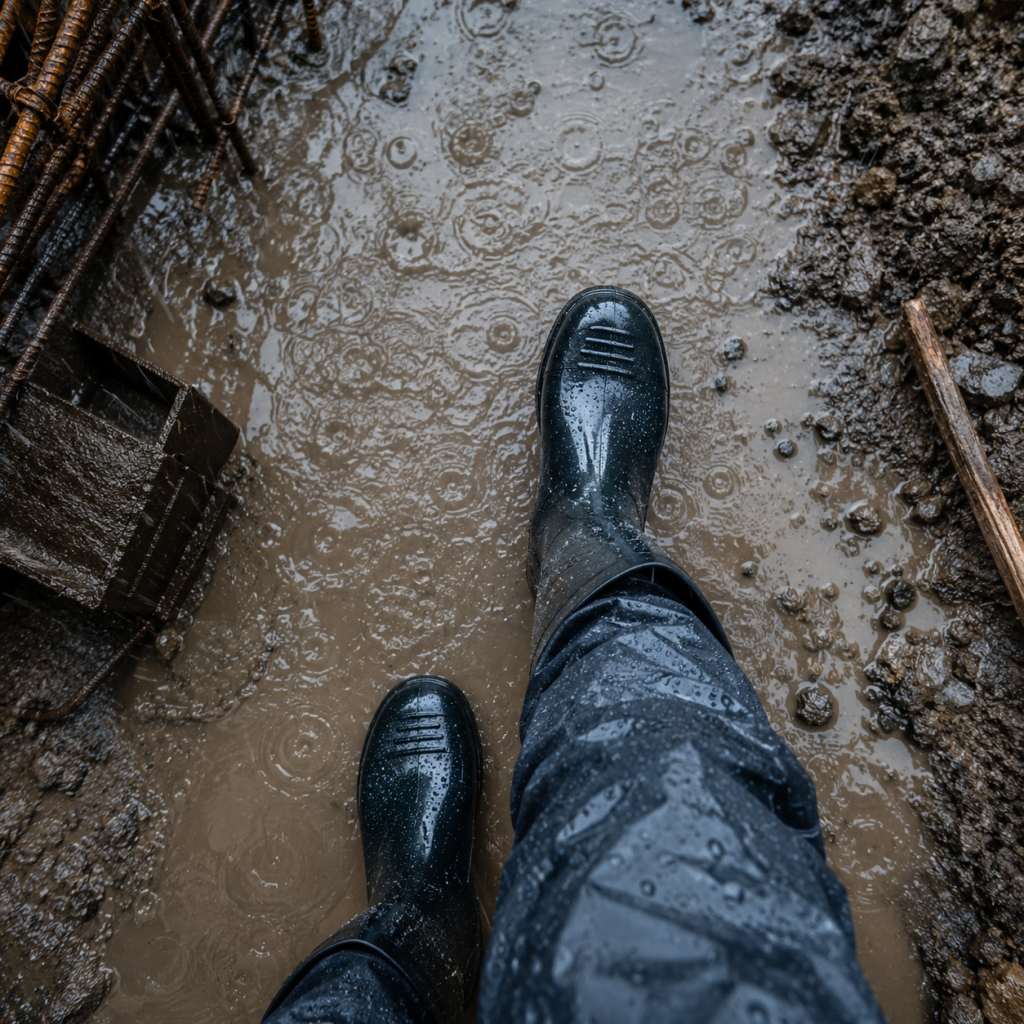
India’s southwest monsoon arrived in Kerala on 4 June 2026. The India Meteorological Department has issued red and orange alerts across Kerala, Karnataka, and the Northeast. For safety and procurement managers, this is the start of the most injury-prone quarter of the industrial calendar.
A recent industry report found that the monsoon season — June through September — accounts for 43 per cent of all annual workplace injury claims, with July alone contributing 13.4 per cent. Total claims jumped 31 per cent year-on-year in 2026. These figures represent workers in construction yards, logistics docks, food processing floors, and manufacturing units — exactly the environments where footwear specification makes a direct difference.
Why Monsoon Multiplies Every Hazard
- Slip and fall — rain-wet concrete, mud, and saturated soil have dramatically lower friction. Footwear without SRB-rated slip resistance becomes a liability.
- Waterlogging — ankle-height flooding is common on construction sites and loading bays. Standard safety shoes offer no protection above the ankle.
- Electrical risk — water near temporary site connections elevates shock risk significantly.
- Chemical contamination — standing water on chemical plant and food processing floors carries contamination risk.
- Worker fatigue — wet, uncomfortable workers tire faster and take more risks.
Sector-by-Sector Risk and Footwear Guide
| Sector | Primary Monsoon Hazard | Recommended Footwear |
|---|---|---|
| Construction — ground workers | Waterlogging, mud, slip | Full-height PVC steel toe gumboot |
| Logistics and warehousing | Wet docks, slippery ramps | Anti-slip PVC safety shoe |
| Food processing | Wet hygienic floors, chemical exposure | Full PVC sealed construction |
| Chemical and pharmaceutical | Contaminated water, tile slip | Chemical-resistant PVC, high shaft |
| Steel and metal plants | Oil and water mix, extreme slip | Anti-slip PU outsole |
Regional Monsoon Progression
| Region | Typical Onset | Key Industries |
|---|---|---|
| Kerala and coastal Karnataka | Early June | Construction, port logistics |
| Mumbai and Maharashtra | Mid-June | Construction, manufacturing |
| Bengaluru and Tamil Nadu | Late June to Early July | Manufacturing, construction |
| Delhi-NCR, UP, Rajasthan | Early to mid-July | Manufacturing, logistics |
| Punjab, Haryana, Gujarat | Mid to late July | Textiles, food processing |
Why July Has the Most Injuries
Insurance data consistently shows July as the riskiest month. Worker adaptation fatigue sets in — workers become less cautious about wet surfaces. Footwear worn into monsoon season without replacement is at peak wear. Drainage systems are saturated. The implication: conduct a footwear inspection in late May or June before risk compounds in July.
Five-Step Pre-Monsoon Footwear Inspection
- Tread depth check — if heel or ball tread is flat, slip resistance is gone. Replace immediately.
- Sole flex test — bend the shoe at the ball. Cracking or separation at the welt means replace.
- Toe cap check — press the toe area. Any flex means the steel cap is compromised. Replace.
- Upper check — cracking or delamination in PVC upper. UV causes brittleness. Replace.
- Anti-slip visual — tread glazed or polished smooth means zero SRB performance. Replace.
Related Reading
- PVC Gumboots for Industrial Use in India
- Anti-Slip Safety Shoes: Why Slip Resistance Is Undervalued
- Safety Footwear for Construction Sites in India
- Safety Shoes for Logistics and Warehouse Workers