
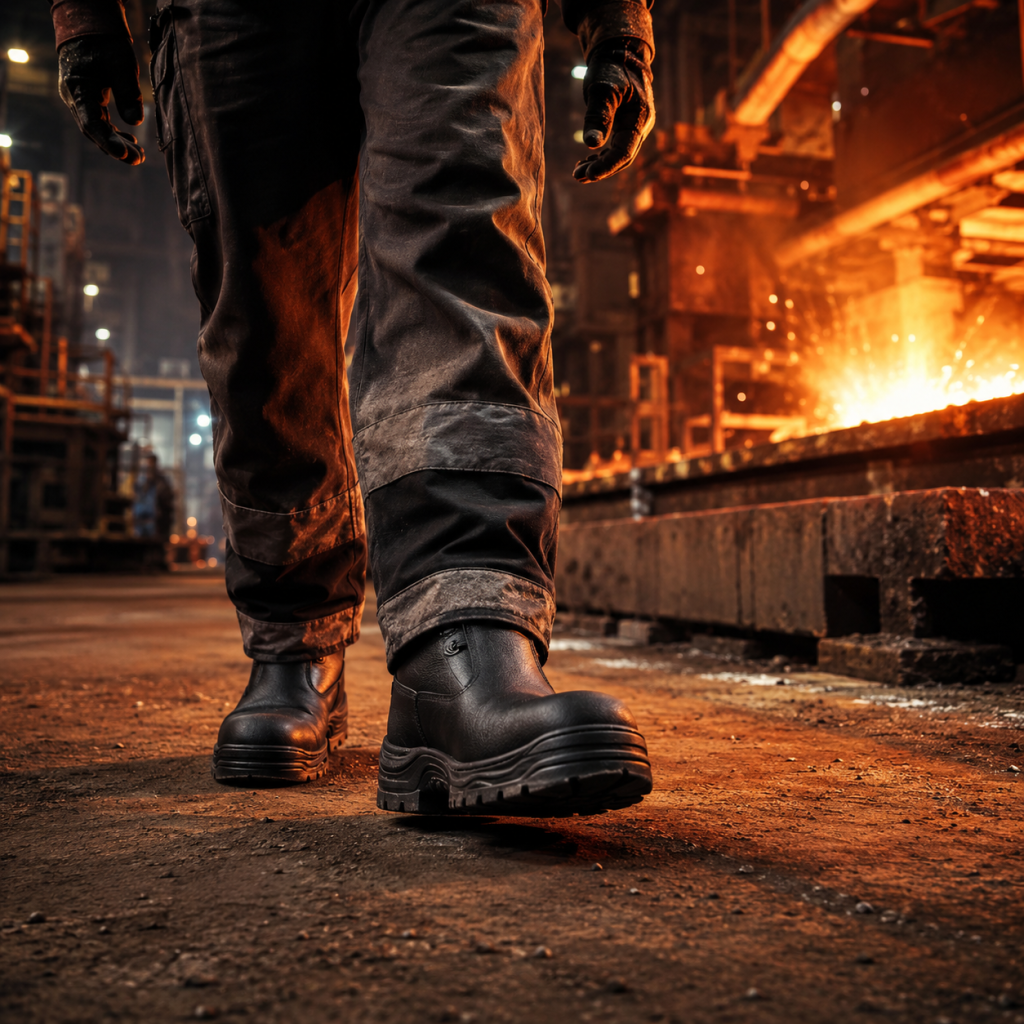
Industrial workplaces carry hazards that are well understood, well documented, and in most cases preventable. When accidents happen, the first response is often to look for a single point of failure. Organisations that consistently improve their safety records look at the system rather than the incident. This piece is about the principles of industrial safety culture that apply in every plant, every shift, every day.
Why Safety Culture Matters More Than Compliance
Regulatory compliance is the floor, not the ceiling. The Factories Act, the OSHWC Code 2020, and IS:15298 all define minimum standards. Plants that focus only on these minimums miss the deeper question: what would it take to make an injury genuinely unlikely, not just technically covered?
PPE — including safety footwear — is the last line of defence. It protects a worker when every other layer has failed. A well-specified steel-toe shoe does not prevent a falling object. It mitigates the injury when the object reaches the foot. Treating PPE as the safety strategy misunderstands how industrial safety works.
The Five Layers of Industrial Safety
| Layer | What It Means | Examples |
|---|---|---|
| 1. Elimination | Remove the hazard entirely | Redesign process to remove worker exposure |
| 2. Substitution | Replace with a lower-risk alternative | Automated handling instead of manual operation |
| 3. Engineering controls | Physical barriers and safeguards | Guarding, exclusion zones, interlocks |
| 4. Administrative controls | Procedures and training | Permit-to-work, toolbox talks, shift handover |
| 5. PPE | Last line of defence for the individual | Steel-toe boots, heat-resistant uppers, anti-slip soles |
Organisations that skip to Layer 5 without addressing Layers 1-4 are managing paperwork, not safety. A worker in a correct IS:15298-certified boot who is inadequately trained, working in an unguarded zone, on an understaffed shift, remains at serious risk.
Common PPE Specification Failures
- Generic procurement — one model for all zones regardless of different hazard profiles
- Price-driven selection — cheapest certified option without considering durability, leading to faster wear and uncertified footwear worn before replacement
- No zone mapping — workers in hazard zones without footwear appropriate to that zone
- Irregular inspection — worn footwear continuing in service past safe wear limits
- No documentation — inability to demonstrate to inspectors what was issued, when, and to whom
Practical Steps for Safety Managers
- Map your zones — identify each area’s specific hazard profile
- Match footwear to zone — do not use a single model if hazard profiles differ significantly
- Set replacement triggers — define clear wear indicators rather than calendar intervals alone
- Maintain records — a basic issue log per worker per zone is your compliance evidence
- Include footwear in induction — workers who understand why they wear what they wear comply more consistently
The Human Side of Safety Compliance
Workers wear PPE consistently when three conditions are met: it fits properly, it does not interfere substantially with their work, and they understand what it protects them from. Footwear that is too tight, too heavy, or visibly degraded will be set aside at the first opportunity.
The best safety footwear programme is one where workers see the equipment as something that protects them. Achieving this requires involvement at the selection stage, proper fitting, honest replacement schedules, and management that models the behaviour it expects. None of this is complicated. All of it requires intention.
Related Reading
- Why Safety Shoes Are Essential in Every Industrial Workplace
- Top Workplace Hazards That Safety Shoes Protect You From
- Safety Footwear Compliance for PSU and Government Procurement
- IS:15298 Explained — The Indian Standard
- Safety Shoes for Steel Plants and Metal Industry Workers