
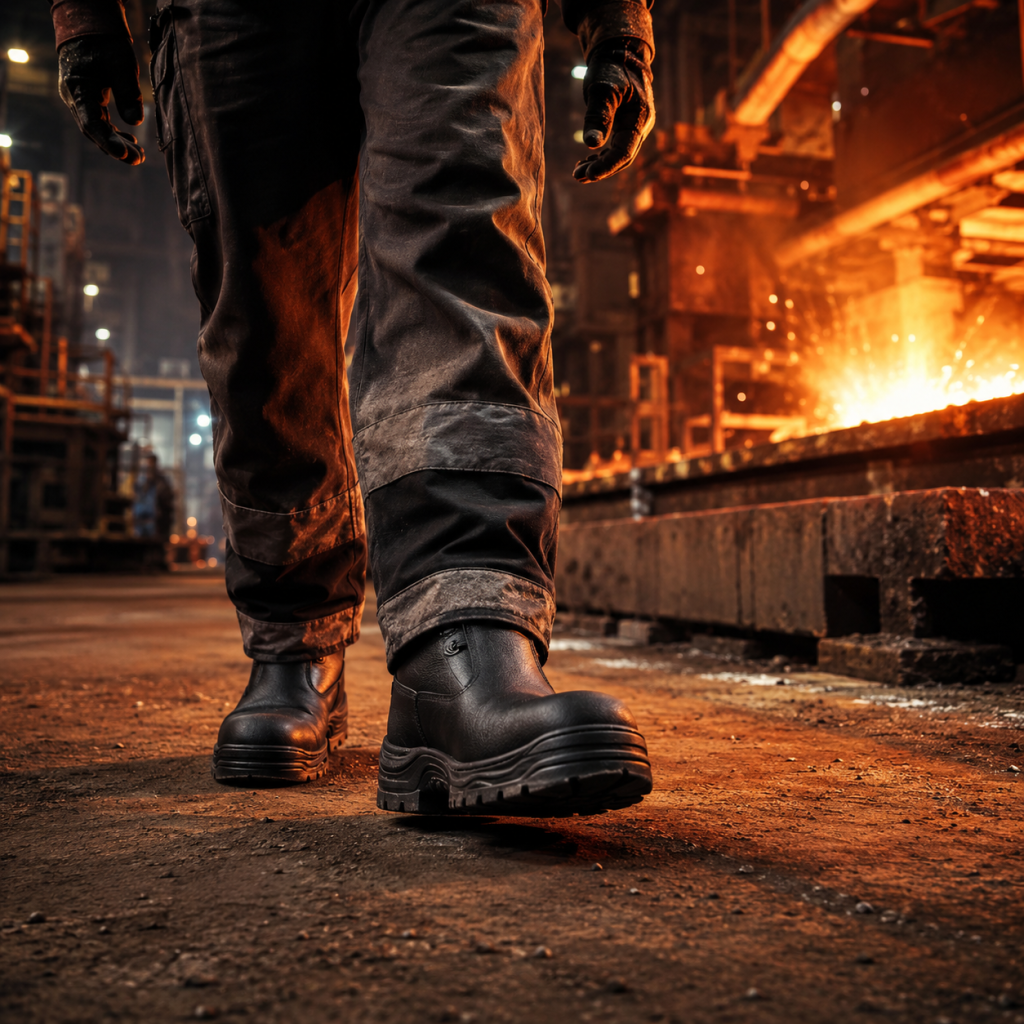
India’s steel sector employs hundreds of thousands of workers in some of the most physically demanding and hazardous industrial environments in the country. The combination of heavy falling objects, extreme heat, molten metal splash risk, sharp metal shavings, and heavily oiled floors creates a hazard profile that places exceptional demands on safety footwear.
The Extreme Hazard Profile
- Heavy falling objects — steel billets, coils, plates; forces can far exceed IS:15298’s 200J requirement
- Molten metal spatter — liquid steel droplets from furnaces; requires heat-resistant upper materials in proximity areas
- Sharp metal shavings and scale — ubiquitous, penetration-resistant midsole essential
- Highly abrasive scale — creates very high outsole wear rates; double-density sole recommended
- Oil and coolant contamination — SRB-rated anti-slip performance essential
Standard Specification for Steel and Metal Plants
- General workshop: Rock DD PU — double-density for abrasive environments, penetration plate, steel toe IS:15298
- Outdoor yard (dry): Rock PU
- Outdoor yard (monsoon): Jungle Boot PVC
Replacement Challenge in Metal Environments
Footwear wears significantly faster in steel and metal environments — typically every 6–9 months rather than 12–18. Double-density outsole models like Rock DD PU extend the replacement cycle by resisting the abrasive metal scale that destroys standard soles.
For zone-by-zone specification support for steel plant procurement, contact our team.
Understanding the Hazard Zones in a Steel Plant
A steel plant is not a single environment — it is a collection of very different work zones, each with its own specific hazard profile. A footwear specification that is correct for the general workshop is under-specified for furnace-adjacent work, and a footwear specification for the outdoor yard is different again from the control room. Zone-specific specification is not a luxury; in a steel plant environment, it is the minimum responsible approach.
| Zone | Specific Hazards | Footwear Specification |
|---|---|---|
| Furnace and casting area | Radiant heat, molten metal splash risk, scale on floor | IS:15298 + heat-resistant sole; double density; metal-free zone — check anti-static requirement |
| Rolling mill | Scale and debris, abrasive floor, oil and water mix, high noise | IS:15298 SRC rated; double-density sole (Rock DD PU) |
| Fabrication and cutting | Metal shavings, sharp edges, impact from billets/plates | IS:15298 with penetration-resistant midsole; SRC slip resistance |
| Outdoor yard and material handling | Uneven ground, heavy vehicle movement, monsoon conditions | IS:15298 standard in dry season; PVC gumboot during monsoon |
| Maintenance (all zones) | Varied — must meet highest-risk zone specification | Double-density IS:15298 as baseline; zone-specific additions |
| Control room and office areas | Minimal — site access requirement | IS:15298 basic specification for site access compliance |
Double-Density Soles — Why They Matter in Steel Environments
Standard single-density PU soles wear at approximately 12–18 months in general manufacturing. In steel and metal environments, where the floor is constantly contaminated with metal scale, grit, and abrasive debris, standard soles wear significantly faster — sometimes within 6 months of commissioning. Double-density PU construction (like the Rock DD PU) uses a harder outer sole layer that resists abrasion far more effectively, extending service life in these environments and reducing the annualised cost per worker.
The Documentation Requirement for Steel Sector Procurement
Large steel sector employers — SAIL plants, RINL/Vizag Steel, Tata Steel, JSW, JSPL, and major private sector steel operations — procure safety footwear through formalised systems requiring full compliance documentation. The standard requirement is:
- BIS IS:15298 licence for each model (current, not expired)
- ISO 9001:2015 certificate from the manufacturer
- Test reports for the specific models being procured
- Price quotation with model code, size-wise breakdown, and unit pricing
Related Reading
- Industrial Safety Culture — Why PPE Is the Last Line of Defence
- IS:15298 Explained — What the Standard Tests
- Safety Footwear for PSU and Government Procurement
- Safety Shoe Replacement Schedule in Metal Environments