
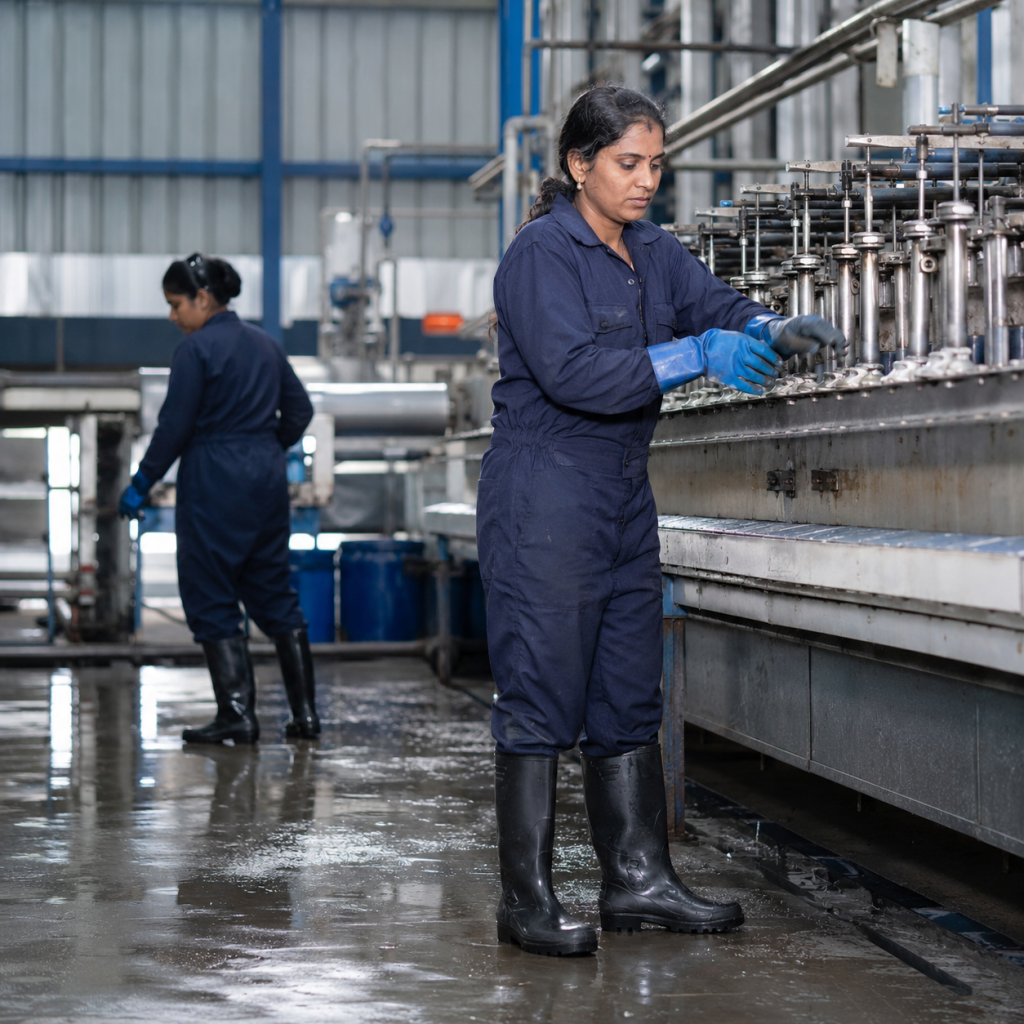
India’s industrial workforce is increasingly female — from garment manufacturing and food processing to pharmaceutical assembly and electronics production. Yet women’s safety footwear needs are systematically underaddressed, with the most common approach being “provide the smallest size from the men’s range” — which is not a solution.
Why Men’s Shoes Don’t Work for Women
- Narrower heel — women’s heels are narrower relative to foot width; men’s shoes are too wide at the heel, causing instability and blisters
- Wider forefoot — women’s forefeet are wider relative to their size; creates pressure points in men’s toe boxes
- Different last shape — the three-dimensional last determines overall fit; men’s lasts do not replicate women’s foot geometry
The Protection Requirement Does Not Change
IS:15298 standards apply equally regardless of who is wearing the shoe. Steel toe must withstand 200J. Slip resistance ratings apply equally. Only the construction changes — not the performance specification.
Industry-Specific Context
- Garment and textile: lightweight IS:15298 shoes for long standing shifts
- Food and beverage: PVC construction in proper women’s sizing
- Pharmaceutical: PU or PVC with GMP hygiene compliance
Procurement for Mixed Workforces
When submitting a bulk quote request, please specify your women worker count and size-wise breakdown separately. Our team will recommend appropriate models and confirm sizing guidance before your bulk order.
The Growing Women’s Industrial Workforce in India
India’s Periodic Labour Force Survey data shows steady growth in women’s participation in manufacturing, particularly in textiles, garments, food processing, pharmaceuticals, and electronics assembly. In Tamil Nadu’s garment industry, women constitute over 80 per cent of the production workforce. In pharma manufacturing in Hyderabad and Ahmedabad, women make up significant portions of production and quality control teams. The electronic assembly plants in Noida, Chennai and Bengaluru have large women workforces on precision lines.
Despite this, safety footwear procurement in most Indian industrial facilities treats the workforce as male by default. Footwear is ordered in sizes 6–12 without accounting for the fact that women’s feet are structurally different — narrower in the heel, broader at the ball, with different arch geometry — and that standard men’s safety shoes in Indian sizes 5–6 do not fit a significant proportion of women workers correctly.
Why Fit Matters for Safety
A poorly fitting safety shoe is not a minor inconvenience — it is a safety hazard. Specific fit failures and their consequences:
| Fit Problem | Consequence |
|---|---|
| Too wide in the heel | Shoe slips during walking; trip and fall risk; blisters |
| Too narrow in the ball | Toe compression; toe injuries from bunched toes near steel cap |
| Too long | Trip hazard; toe cap positioned incorrectly relative to toes |
| Too heavy for foot size | Fatigue; reduced mobility; workers remove shoe at first opportunity |
Workers who find their safety shoes uncomfortable will remove them — creating a zero-protection situation while maintaining a paper compliance record. Fit is the first requirement for effective PPE.
IS:15298 Applies Equally — There Is No Separate Standard
There is no separate Indian standard for women’s safety footwear. IS:15298 is the universal requirement for industrial safety footwear regardless of gender. The certification tests — 200-joule impact, 15kN compression, SRB slip resistance — apply equally. What differs is the last (the form on which the shoe is built), the width specifications, and the weight of the upper and sole materials.
When specifying safety footwear for women workers, the requirement is IS:15298 certified footwear built on a last appropriate for the female foot — which means narrower heel, appropriate ball width, and sized correctly for smaller foot dimensions.
Sector-Specific Considerations
Garment and textile manufacturing — lightweight PU safety shoes with slip resistance on tile floors. Emphasis on comfort for standing shifts of 8+ hours. Jumbo Z+ PU for maximum cushioning.
Electronics assembly — anti-static specification required. Lightweight, precision-friendly. Confirm ESD requirements with production line specification.
Food processing — PVC safety shoes with smooth upper for hygiene zones. Full gumboots for wet processing areas. Size-wise coverage essential as food processing workforces can be 50–80% women.
Pharmaceutical production — same GMP requirements apply. PVC easy-clean construction for production floors; confirm anti-static for packaging lines.
Related Reading
- Safety Shoes for Food Processing
- IS:15298 — What the Certification Covers
- Anti-Slip Safety Shoes — Slip Resistance for All Workers
- Safety Shoe Buying Guide