
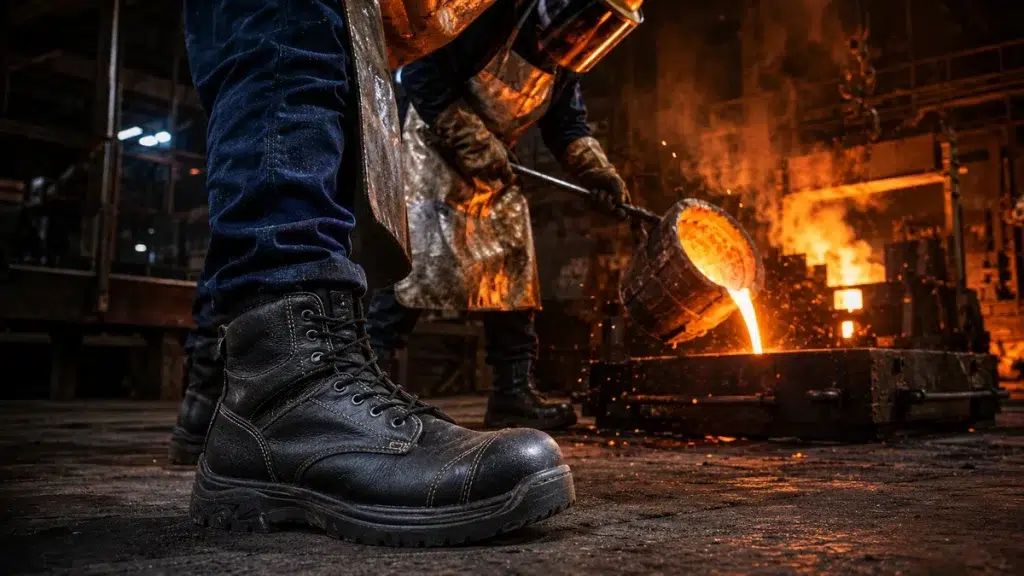
India is home to hundreds of foundries, steel remelting units, glass manufacturing plants, and ceramic kilns. The workers in these facilities face a hazard that most industrial safety conversations underplay: sustained exposure to extreme heat at floor level. Conventional safety shoes — even well-made ones — can fail catastrophically when exposed to radiant heat, molten splatter, or prolonged contact with hot surfaces.
This article explains what heat-resistant safety shoe ratings actually mean, which industries in India need them most, and how to match the right product to the right environment.
Why Ordinary Safety Shoes Fail in High-Heat Environments
A standard PU (polyurethane) safety shoe outsole softens at temperatures above approximately 80°C. In a foundry or smelting environment where floor temperatures can exceed 200°C in certain zones, that means the outsole can deform, compress, and lose its anti-slip properties in under an hour of sustained exposure.
Beyond the outsole, the steel toe cap itself becomes a hazard if exposed to sufficient radiant heat — it can transfer heat to the foot faster than non-metallic alternatives.
Rubber outsoles perform better at elevated temperatures, but they vary widely in compound formulation. Only outsoles that have been tested and rated to a specific standard can be trusted in a high-heat workplace.
Understanding Heat Ratings in Safety Footwear Standards
IS:15298 (India’s safety footwear standard, aligned with EN ISO 20345) defines three distinct heat-related performance designations:
HRO — Heat-Resistant Outsole
The outsole is tested at 300°C for 60 seconds and must not show cracking, blistering, or reduction in thickness exceeding 4mm.
Who needs it: Workers in proximity to hot surfaces but not in direct contact with molten material — glass furnace assistants, ceramic kiln operators, mild steel fabrication, heat treatment operations.
HI — Heat Insulation (from underfoot)
The insole temperature must not exceed 42°C after 30 minutes when placed on a surface at 150°C.
Who needs it: Workers who stand or walk on heated floors — foundry floors near tapping points, rolling mill areas, heat treatment bay floors.
CI — Cold Insulation
The reverse of HI — insole must not drop below a certain temperature. Less relevant for Indian foundry environments, but important in cold storage and refrigerated warehousing.
Industries in India That Require Heat-Resistant Footwear
Iron and Steel Foundries
India is the world’s second-largest steel producer. Foundries across Rajasthan, Maharashtra, Gujarat, Punjab, and Uttarakhand employ hundreds of thousands of workers near induction furnaces, ladles, and mould lines. HRO + HI rated shoes are not optional — they are survival equipment.
Aluminium and Non-Ferrous Smelting
Aluminium smelting and die-casting plants (major clusters in Gujarat and Maharashtra) operate at temperatures where regular shoe outsoles fail within a working week.
Glass Manufacturing
India’s flat glass, container glass, and specialty glass industries (primarily in Firozabad, Bharuch, and Pune) expose workers to sustained radiant heat from furnaces operating at 1,200–1,500°C. Floor and ambient temperatures around the working area can be extreme.
Ceramic and Refractory Kilns
Workers loading and unloading industrial kilns in the ceramic belt (Morbi, Gujarat) regularly step on surfaces with residual heat. HI-rated footwear reduces the risk of burns through the sole.
Forging and Pressing
Hot forging operations produce scale and slag that falls to the floor, creating randomly distributed hot zones. Heat-resistant outsoles with oil resistance are ideal for this environment.
What to Look For When Buying Heat-Resistant Safety Shoes
- Certification, not just claims
The shoe must carry a test certificate from an accredited laboratory for its HRO, HI, or CI rating. A shoe labelled “heat resistant” without third-party certification is a marketing claim, not a safety specification. - Outsole material
Nitrile rubber and SBR (Styrene-Butadiene Rubber) compounds perform better than standard PU in sustained heat. However, compound quality varies. Always ask for the outsole specification. - Upper material
Full-grain leather with chrome-free tanning retains its structural integrity at higher temperatures than synthetic uppers. In extreme heat zones, leather uppers are preferred. - Lining and insole
In HI-rated shoes, the insole is specifically engineered to impede heat conduction. Replacing the insole with a non-rated aftermarket version nullifies the shoe’s HI rating — an important point for safety managers to communicate to workers. - Toe cap material
In environments where radiant heat is very high (close furnace proximity), composite toe caps are preferable over steel — steel conducts heat efficiently, composite does not.
Common Mistakes in High-Heat PPE Footwear Purchasing
Mistake 1: Buying the same shoe for all plant workers
Workers in the office area of a foundry and workers on the furnace floor have very different exposure levels. Differentiate your PPE spec by work zone.
Mistake 2: Prioritising price over compound quality
A cheaper outsole that fails at 120°C costs far more in medical claims and lost productivity than a correctly rated shoe.
Mistake 3: Skipping replacement schedules
Heat-resistant compounds degrade with repeated thermal cycling. A shoe that tested to HRO standard when new may not retain that performance after a year of daily furnace floor use. Establish a documented replacement schedule.
Mistake 4: Not checking compatibility with other PPE
In some foundry environments, workers wear heat-resistant spats or gaiters over the shoe. Ensure the shoe profile and ankle construction work with the additional PPE layer.
Indcare Safety Shoes for Heat-Intensive Environments
Mittal Safety Works manufactures Indcare safety shoes with a focus on industrial durability. Our rubber-soled variants are compounded for elevated temperature resistance and are suitable for deployment in forging, fabrication, and moderate foundry environments.
For extreme foundry or molten metal environments, we supply through our distribution network and can provide product datasheets that specify the tested temperature range.
Our quality management process is certified under ISO 9001:2015, and our products carry BIS certification to IS:15298. When your safety audit requires documentation, we have the paper trail ready.
Conclusion
Heat-resistant safety shoes are not a niche product — they are an essential specification for a broad range of Indian industries. Understanding the difference between HRO, HI, and generic “heat resistant” claims can mean the difference between genuine worker protection and a false sense of security.
Choose safety footwear with certified heat resistance ratings, matched to the specific temperature exposure in your workplace.